There is a moment in the history of design when optimism became a visual language. In the late 1950s and through the 1960s, a generation of designers on both sides of the Atlantic looked at the space race, at the promise of technology, at the sheer audacity of the era, and translated all of it into objects. Furniture, ceramics, textiles — and above all, lighting. The result was the Atomic Age aesthetic: a body of design that remains, sixty years later, among the most immediately recognisable and most emotionally resonant in the canon.
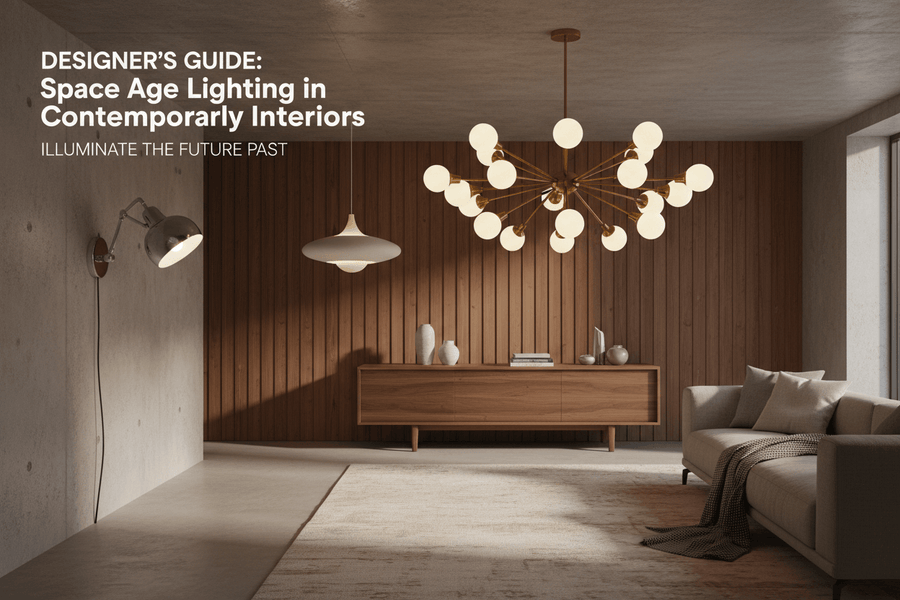
This guide is for those who want to use space age lighting in contemporary interiors — not as pastiche, not as costume, but as a genuinely considered design choice that brings warmth, personality, and historical intelligence to a room. We will cover the key forms — the sputnik chandelier, the eyeball spot, the saucer pendant — and how to specify each one for the rooms and projects where they perform best.
Understanding the Atomic Age aesthetic
The Atomic Age in design ran roughly from the mid-1950s to the mid-1970s, overlapping with and feeding into the broader mid-century modern movement. Its visual characteristics are distinct: starburst and sunburst forms, spherical globes on extended arms, flying saucer profiles, the suggestion of orbit and trajectory in static objects.
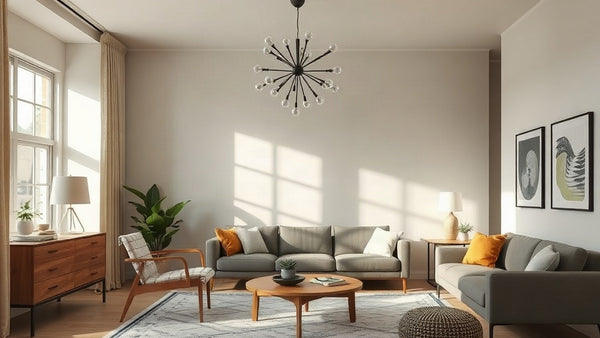
Lighting was the natural home for this aesthetic. The lightbulb itself — a glowing sphere, a contained energy source — was already a small piece of space age technology. Designers simply made the metaphor explicit. The 60s sputnik chandelier, with its cluster of globes on radiating arms, is perhaps the purest expression: a direct visual quotation of the satellite that gave the era its defining image, domesticated into a ceiling fixture.
For the contemporary specifier, this tradition offers something genuinely valuable: a set of forms with strong visual identity, proven longevity, and a warmth of association that purely contemporary design rarely achieves. A room with a well-chosen Atomic Age light fixture feels designed in a way that is difficult to articulate but immediately apparent.
A thorough grounding in the history and vocabulary of this movement is available in our mid century modern lighting guide — essential reading for anyone specifying seriously in this space.
The sputnik chandelier: the defining ceiling fixture of the era
The 60s sputnik chandelier is the most architecturally ambitious form in the space age lighting canon. At its best, it does not merely hang from the ceiling — it colonises the vertical space of the room, extending outward in multiple directions and creating a presence that is felt before it is consciously registered.
For specification purposes, the sputnik chandelier divides into two broad categories. The first is the classic multi-arm form: a central sphere or disc from which a series of arms extend, each terminating in a small globe or bare bulb. The visual effect depends on the number of arms, the arm length, and the relationship between arm length and room scale. In a room with a ceiling height of 3 metres or above, a sputnik with arms of 50–60cm creates genuine spatial drama. In lower-ceilinged rooms, a more compact version with shorter arms is more appropriate — the form reads just as strongly at smaller scale.
The second category is the modern interpretation: pieces that take the formal language of the sputnik — radiating arms, spherical terminals, a sense of orbital energy — and reinterpret it with contemporary materials and proportions. These are often easier to specify into rooms that are not fully committed to a period aesthetic, because the reference is clear but not overwhelming.
The Atomic Sputnik Chandelier from Nauradika is the piece we recommend most consistently for this application. It captures the essential geometry of the original without over-literalising it — the arms are proportioned for contemporary ceiling heights, the finish works across both period and modern interiors, and the quality of construction is appropriate for contract as well as residential use. For dining rooms, double-height entrance halls, and living rooms with ceiling heights above 2.8 metres, it is difficult to improve on.
The retro eyeball spotlight: precision meets personality
While the sputnik commands a room from above, the retro eyeball operates at a more intimate scale. The eyeball spot — a spherical housing containing a directional lamp that can be rotated within its socket — was one of the defining task lighting forms of the late 1960s and 1970s. Originally developed for track and recessed applications in commercial and retail environments, it migrated into residential use as designers recognised its combination of practical flexibility and visual character.
The appeal of the eyeball for contemporary specification is threefold. First, it is directional: the ability to aim the light source precisely where it is needed makes it genuinely useful in ways that fixed downlights are not. Second, it is visually interesting in a way that no recessed fitting can be: the spherical housing protrudes from the surface it is mounted on, creating a shadow and a presence. Third, it is unmistakably of its era — there is no mistaking an eyeball spotlight for a contemporary fitting, which means it makes a clear statement about the design direction of the room it inhabits.
For contemporary use, the eyeball works particularly well in rooms that already have a strong mid-century modern direction: paired with a sputnik chandelier as the ambient fixture in a living room, used as picture lighting in a study or library, or mounted in series along a kitchen ceiling to provide task lighting with considerably more character than a standard recessed downlight track. The Mad Men Inspired Ceiling Lights at Nauradika capture this aesthetic precisely — the kind of fitting that would have been entirely at home in a 1960s Manhattan apartment and looks equally considered in a contemporary London townhouse.
The saucer ceiling light: Atomic Age geometry at its most refined
The flying saucer form — a flattened disc, wider than it is tall, typically in aluminium, glass, or acrylic — is perhaps the most geometrically pure expression of the space age aesthetic. Where the sputnik reaches outward and the eyeball points inward, the saucer ceiling light sits still. Its power is in its profile: seen from below, it presents a clean circular form; seen from the side, it is almost impossibly slim, floating in space with a quality that feels genuinely futuristic even now.
For specification, the saucer pendant works best in rooms where the ceiling is low enough to make its thinness felt — approximately 2.4–2.7 metres is ideal. In these rooms, the saucer's slim profile means it does not compress the vertical space the way a deeper pendant would. It sits lightly, almost hovering, which creates a sense of spaciousness rather than the slight claustrophobia that heavy pendants can produce in lower-ceilinged rooms.
The saucer form also photographs exceptionally well — a practical consideration for hotel rooms, serviced apartments, and any residential project where photography will be used for marketing or publication. Its clean geometry creates strong, legible images in a way that more complex pendant forms sometimes do not.
The 50s Retro Flying Saucer Ceiling Light from Nauradika is one of our most consistently popular pieces with architects and interior designers working on mid-century modern and retro revival projects. Its proportions are faithful to the original 1950s and 60s production pieces, the finish is available in options that work across both period and contemporary schemes, and the light quality — diffused, warm, omnidirectional — is exactly what you want from a primary ceiling fixture in a living room or bedroom.
Combining space age forms across a project
The most sophisticated use of Atomic Age lighting is not the single statement piece — it is the considered distribution of space age forms across multiple rooms and scales within a project. A sputnik chandelier in the double-height entrance hall, eyeball spots in the study and kitchen, saucer pendants in the bedrooms — the visual language reads as coherent and intentional throughout the project without any single room feeling over-specified.
The key to making this work is restraint in everything else. Space age lighting forms are strong; they do not need support from space age furniture, space age textiles, and space age accessories simultaneously. In most residential projects, one or two pieces of period lighting in a room of otherwise contemporary or neutral furnishing creates the right balance: the lighting provides the historical reference and the personality, while the rest of the room provides the liveable background against which those references can be read.
For hospitality and commercial projects, the space age aesthetic translates particularly well into bar areas, private dining rooms, and hotel lobbies — spaces where a degree of theatrical personality is appropriate and where the durability and visual impact of a well-made Atomic Age fixture can justify the specification investment.
Buying and specifying space age lighting
A few practical notes for those specifying these pieces on real projects:
Bulb type: the original sputnik and eyeball forms were designed around incandescent and halogen sources. Contemporary reproductions should specify LED equivalents carefully — the colour temperature matters enormously. For space age pieces, 2200–2700K is the correct range. Anything cooler reads as clinical and works against the warmth of the aesthetic.
Ceiling rose and canopy: for sputnik chandeliers in particular, the ceiling rose and canopy are part of the visual composition. A small, mean canopy on a large sputnik looks wrong — the canopy should be proportioned to the fixture, not minimised. Check manufacturer specifications before ordering.
Weight: multi-arm sputnik chandeliers can be surprisingly heavy, particularly in metal-finish versions. Confirm ceiling joist positions and fixing capacity before specifying, particularly in older properties with lath-and-plaster ceilings.
Nauradika's full range of vintage and retro light fixtures includes the complete spectrum of space age forms — from sputnik chandeliers to saucer pendants — curated for both residential and contract specification. Trade accounts are available for architects, interior designers, and commercial specifiers — register for project pricing here.
Nauradika Trade