Wall lighting is the most underspecified category in residential and commercial interiors. Clients focus on pendants and floor lamps — the pieces that arrive in boxes and make an immediate visual impression — and wall lights are added as an afterthought, if at all. The result is rooms that are adequately lit from above but feel flat, one-dimensional, and somehow unresolved, however well everything else has been chosen.
The designers who produce the most consistently impressive interiors treat wall lighting not as supplementary but as structural. A well-placed scandinavian wall lamp does something that no ceiling pendant can do: it lights the vertical surfaces of a room. It activates the walls, creates depth and shadow, and produces the layered quality of light that distinguishes a designed interior from a merely furnished one.
This guide covers the full range of Nordic wall lighting — from the scandinavian bedside lamp to the corridor sconce, from the reading light above a desk to the statement wall fixture in a living room — and how to specify each one for maximum effect.
Why Scandinavian wall lighting leads the category
Nordic design's contribution to wall lighting follows the same principles that have made it dominant in pendant and floor lamp design: a commitment to functional excellence expressed through restrained, considered form. A scandi wall sconce is not designed to be noticed; it is designed to do its job so well that the quality of the room it inhabits feels inevitable rather than achieved.
This functional intelligence takes several specific forms in Scandinavian wall lighting. The shade geometry is typically designed to direct light where it is needed — downward for ambient and task applications, upward for accent and mood — while shielding the source from direct view. The materials are chosen for their behaviour under light as much as their appearance in daylight: brushed metals that catch the light softly, frosted glass that glows rather than glares, natural wood that warms under incandescent illumination.
The fixing and adjustment mechanisms receive the same design attention as the visible elements. A Nordic wall light should be straightforward to install, easy to adjust, and possible to re-position without damage to the wall surface. These are not glamorous design criteria, but they matter enormously on real projects where time and budget constraints mean that a fitting that cannot be installed cleanly will simply not be used.
Mid-century modern wall sconces: the historical foundation
The contemporary Scandinavian wall light tradition is rooted in the mid-century modern wall sconces produced by Nordic designers from the 1940s through the 1970s. This was a period of extraordinary productivity in Scandinavian design, driven by the intersection of craft traditions, design education, and the postwar demand for well-made, affordable domestic objects.
The wall sconces of this era were characterised by a formal intelligence that remains difficult to improve on. The arm — where it existed — was designed to position the shade at precisely the right distance from the wall for the intended application. The shade geometry controlled the light distribution with an accuracy that contemporary designers still reference. The material palette — spun aluminium, brushed brass, teak, beech — has aged into something that feels richer rather than dated.
For contemporary specification, mid-century Nordic sconces divide into two categories: original vintage pieces, which are increasingly scarce and expensive, and contemporary pieces that work within the same formal language. At Nauradika, we focus exclusively on the second category — pieces that capture the design intelligence of the originals at prices that make them viable for both residential and contract projects.
The Swing Arm Nordic Loft Wall Lamp is one of the most functionally faithful contemporary expressions of the mid-century sconce tradition. The articulated arm allows precise positioning for reading or task applications, the shade directs light exactly where it is needed, and the overall form — restrained, considered, unmistakably Nordic — works across a wide range of interior directions.
The scandinavian bedside lamp: form and function in the most important room
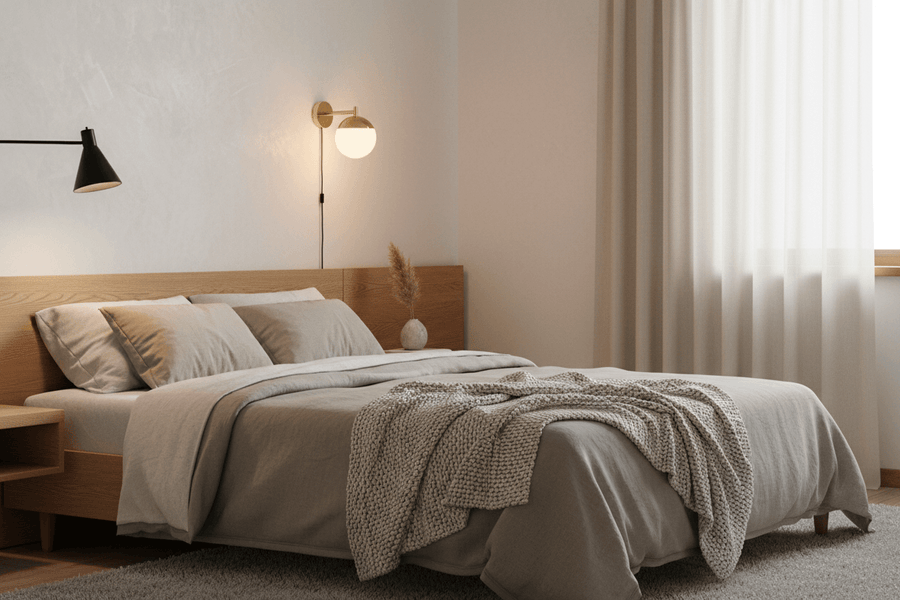
The bedroom is where wall lighting earns its clearest justification. A well-specified scandinavian bedside lamp — mounted on the wall rather than standing on a bedside table — frees up table surface space, delivers better directed light for reading, creates a cleaner visual line along the wall, and can be switched independently for each side of the bed without the cord management issues that accompany table lamps.
For bedside wall lighting, the specification criteria are precise. The bottom of the shade should sit at approximately shoulder height when seated upright in bed — typically 130–145cm above finished floor level, depending on mattress and bed frame height. The shade should direct light toward the pillow and the reading matter, not outward into the room where it would disturb a sleeping partner. A dimmer function — either integral to the fitting or via a dimmer switch — is essential; the ability to drop from reading brightness to near-dark without leaving bed is one of those quality-of-life improvements that clients consistently cite as among the most valuable changes in a bedroom redesign.
The Nordic Bell Bedside Wall Lamp from Nauradika is designed precisely for this application. The bell-form shade directs light downward and toward the bed, the mounting height positions it correctly for most standard bed and mattress combinations, and the clean Nordic aesthetic — available in finishes that work across a wide range of bedroom palettes — makes it one of our most consistently specified pieces. For a more characterful, mid-century inflected option, the Mid-Century Modern Bedside Wall Lamp brings the formal confidence of 1960s Nordic design to the contemporary bedroom.
The scandinavian wall lamp in living rooms
In living rooms, scandinavian wall lamp placement is about creating layers of light that work independently and together. The standard approach — a ceiling pendant providing ambient light, supplemented by floor and table lamps — leaves the walls dark. Dark walls in a living room create a box effect: the room feels smaller, flatter, and more enclosed than it actually is.
Adding wall lights at two or three points around the room perimeter breaks this effect. The light on the vertical surfaces creates apparent depth, making the room feel larger and more three-dimensional. The wall lights can be operated independently of the ceiling pendant, allowing the ambient level to be reduced while the wall lighting maintains a warm, intimate atmosphere for evening use.
For living room wall lighting in a Nordic or mid-century modern scheme, the key specification decision is between uplighting and downlighting. An uplighter — a shade that directs light upward toward the ceiling — creates a soft wash of reflected light that adds warmth to the upper part of the room without creating glare at eye level. A downlighter creates a more focused pool of light on the wall surface below, which is more useful for accent and task applications but less effective for general atmosphere.
The Collection of Modern Nordic Wooden Wall Lights offers a range of options across both directions — the natural wood construction brings warmth to the wall surface even in the unlit state, and the range of shade forms covers both uplight and downlight applications. For a more refined, architectural option, the Nordic Glow Tubular Sconce delivers a clean, vertical line of light that works particularly well in rooms with strong architectural geometry.
Corridor and staircase wall lighting
Corridors and staircases present a specific wall lighting challenge: the need for adequate wayfinding light combined with a visual quality that does not make these transitional spaces feel clinical or institutional. The solution that Nordic designers arrived at — and that remains the most satisfying available — is a series of small, well-spaced sconces that provide overlapping pools of warm light along the full length of the corridor or staircase run.
Spacing is typically 1.5–2 metres between fittings, at a mounting height of 140–160cm above floor level. This positions the light source above eye level when moving through the space, which prevents glare while ensuring adequate illumination of the floor surface. The fittings themselves should be as unobtrusive as possible — the light quality is the priority, not the visual complexity of the fitting.
For staircase applications, the wall light should be on a two-way or multi-way circuit, operable from both the bottom and top of the stair. In listed buildings or properties where surface wiring is not acceptable, a battery-operated or rechargeable wall light — such as the Rechargeable Bedside Wall Lamp — provides a cable-free solution that can be installed without any building work.
Specifying scandi wall sconces across a project
The most effective approach to wall lighting specification is to treat it as part of the lighting design from the outset rather than adding it at the end. This means identifying the wall lighting positions during the design stage, ensuring that the electrical first fix includes wall light circuits at the correct heights, and selecting fittings that are consistent with the overall design language of the project.
For projects with a strong Nordic or mid-century modern direction, the wall lighting should share the material and formal language of the pendant and floor lighting. This does not mean identical fittings throughout — variation in form adds interest — but it does mean consistency of material: if the pendants are brushed brass, the wall lights should be brushed brass or a material that reads as complementary rather than contradictory.
For contract projects — hotels, serviced apartments, commercial offices — wall lighting often needs to meet specific lux level requirements as well as aesthetic criteria. Confirm the lux levels required for each application with the electrical engineer before specifying, and check that the chosen fittings can deliver those levels at the intended mounting height and spacing.
Browse the full range of Scandinavian wall light fixtures at Nauradika — from bedside sconces to corridor series and living room statement pieces. Trade accounts with project pricing are available for architects, interior designers, and commercial specifiers — register here to access trade pricing on your next project.
Nauradika Trade