Some design forms are so well resolved that they never really go away. They recede for a decade or two, absorbed into the background of the visual culture that produced them, and then return — not as nostalgia, but as rediscovery. The mushroom lamp is one of those forms. After years as a footnote in mid-century modern retrospectives, it is now one of the most searched and most specified lighting shapes in contemporary interiors. If you have not yet considered it seriously, this guide will explain why you should.
We will look at where the form came from, why it works so consistently well across different room types and scales, and how to use it — from a 70s mushroom table lamp on a bedside table to a mushroom ceiling light as the primary fixture in a living room or hotel suite.
The origins of the mushroom form
The mushroom lamp emerged from the confluence of two dominant forces in 1960s and 70s design: the space age aesthetic and the Italian craft tradition. Designers working in Milan, Copenhagen, and Stockholm were simultaneously experimenting with organic forms derived from nature and with the new synthetic materials — moulded acrylic, fibreglass, blown glass — that made those forms manufacturable at scale.
The mushroom's appeal to this generation of designers was straightforward: it is one of the few organic forms that also happens to be an almost perfect lampshade geometry. The broad, domed cap diffuses light softly in all directions. The narrow stem conceals the cord and the fitting. The proportional relationship between cap and stem creates a form that reads as both natural and designed — organic without being arbitrary.
The most celebrated examples — produced by studios including Guzzini, Harvey Guzzini, and various Scandinavian workshops — were made in coloured acrylic or mouth-blown glass, often in the amber, rust, and white tones that defined the palette of the era. Many of these original pieces now sell for significant sums at specialist dealers. What Nauradika offers is the design intelligence of that tradition at prices that make it viable for a bedroom, a kitchen, or a hospitality project.
The mushroom wall light: redefining bedside and corridor lighting
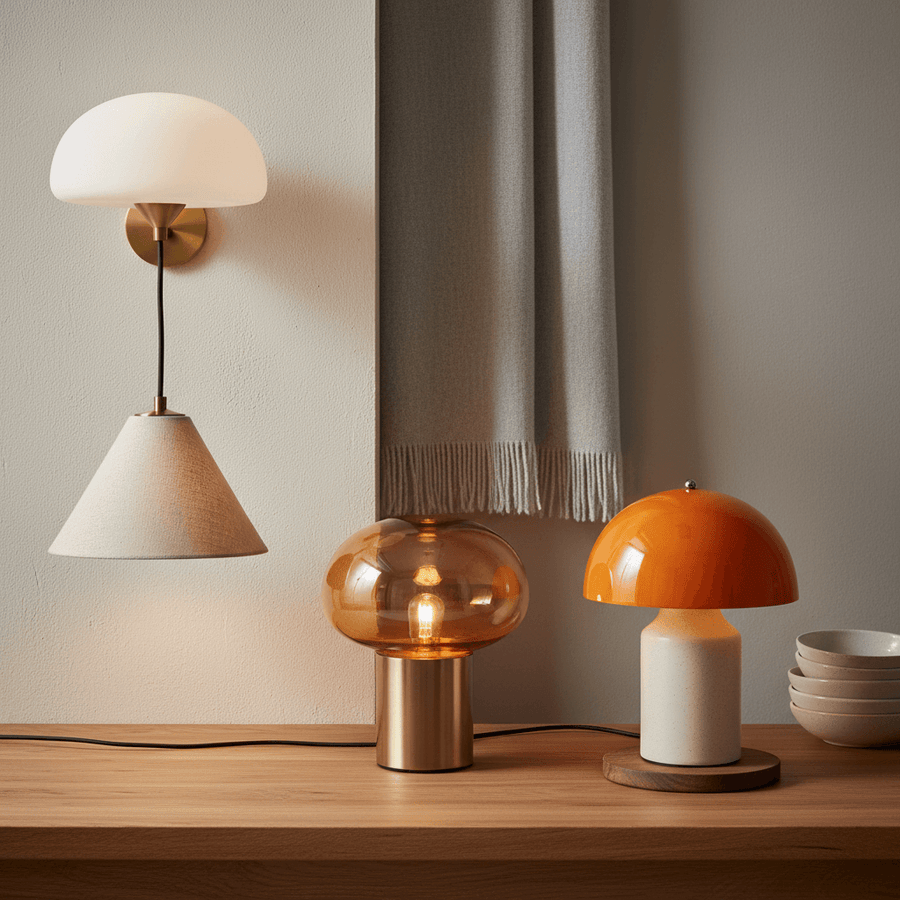
The mushroom wall light is one of the most versatile pieces in contemporary residential specification. Mounted at bedside height, it replaces the traditional table lamp with something that takes up no surface space, delivers better directed light for reading, and adds a sculptural quality to the wall that a freestanding lamp cannot match.
For bedroom specification, the mushroom wall light works particularly well in pairs — one either side of the bed, mounted at approximately 140–150cm above finished floor level. At this height, the shade sits roughly at eye level when seated upright in bed, which is the correct position for a reading light. The stem angle should direct the open face of the shade toward the pillow rather than outward into the room.
In corridors and on staircases, a series of mushroom wall lights at regular intervals creates a rhythm that is both practical and architectural. The soft, diffused light from each fitting overlaps with the next, eliminating the pools-and-shadows effect that plagues corridors lit with downlights alone.
The Modern Mushroom LED Rechargeable Light from Nauradika is one of our strongest performers in this category — the rechargeable format makes it particularly valuable in listed buildings or refurbishment projects where running a new cable to a wall position is impractical or impossible. For a more traditional hardwired specification, the Nordic Mushroom Table Lamp in retro-inspired glass and iron is an outstanding piece — the glass cap in particular has the material warmth of the original 1970s production pieces.
The mushroom ceiling light: a statement that needs no explanation
Scaled up to ceiling pendant format, the mushroom form becomes something else entirely. A mushroom ceiling light of 40cm diameter or above has genuine architectural presence — it reads from across a room, creates a strong shadow line on the ceiling plane above it, and delivers the kind of warm, diffused ambient light that recessed downlights cannot approximate.
For living rooms, the mushroom ceiling pendant works best in rooms with a strong mid-century modern or retro direction — paired with low-slung furniture, natural materials, and a warm colour palette. It is less at home in rooms with a purely contemporary aesthetic; its organic form sits in mild tension with the hard geometry of modern minimalism, which can work brilliantly or feel slightly awkward depending on the execution.
For dining rooms, a large mushroom pendant hung 65–70cm above the table surface creates a pool of warm light that flatters both food and faces. The diffused quality of the light — no harsh shadows, no direct glare — is particularly well suited to the dining context.
For hotel rooms and serviced apartments, the mushroom ceiling light is an increasingly common specification choice. It reads as designed and intentional without being alienating, it references a design language that resonates with the demographic increasingly driving hospitality spending, and it is robust enough for the demands of a contract environment.
The mushroom glass lamp: when material becomes the message
The finest mushroom lamps of the 1970s were made in glass, and the finest contemporary versions continue that tradition. The mushroom glass lamp — whether in clear, smoked, amber, or white opaline glass — behaves differently from its acrylic counterpart in ways that matter.
Glass transmits light rather than simply diffusing it. A mushroom glass lamp in operation glows from within — the cap becomes a luminous object rather than a lit shade. The variations in the glass itself, the slight thickness changes, the surface texture, the colour depth — all of these create a quality of light that is genuinely difficult to achieve with any other material.
In practical terms, glass mushroom lamps require slightly more careful handling on site and are generally heavier than acrylic equivalents. For residential specification, this is rarely a concern. For high-traffic hospitality environments, it is worth considering whether the material robustness of a quality acrylic piece might be more appropriate than glass, however beautiful the glass option is.
The Nordic Mushroom Table Lamp in Glass and Iron sits at the intersection of these qualities — the glass cap delivers the material warmth and glow of the original pieces, while the iron base provides the weight and stability that a quality lamp requires. It is the piece we most frequently recommend to designers specifying for master bedrooms, boutique hotel rooms, and high-end residential living rooms.
The 70s mushroom table lamp: bedside, desk, and beyond
At table lamp scale, the mushroom form is at its most domestic and most versatile. A 70s mushroom table lamp on a bedside table, a side table in a reading corner, or a console in an entrance hall brings the warmth and character of 1970s design into a space without requiring any commitment beyond placing a lamp.
This accessibility is part of what is driving the current revival. Unlike a statement pendant or a structural wall light, a table lamp can be moved, repositioned, and replaced without any building work. For clients who are not yet ready to commit fully to a retro or mid-century modern direction, a pair of mushroom table lamps is often the right starting point — a way of testing the aesthetic in a low-risk format before specifying it at a larger scale.
The 60s Italy Designer Mushroom Table Lamp from Nauradika is one of the most faithful contemporary expressions of the original form — the proportions, the material palette, and the quality of the diffused light all reference the Italian studio production of the era directly. Pair two on a console table in an entrance hall and the effect is immediate.
Specifying mushroom lighting across a project
One of the most effective ways to use the mushroom form is as a thread running through a project at multiple scales. A mushroom ceiling pendant in the living room, mushroom wall lights in the master bedroom, and mushroom table lamps on the bedside tables creates a sense of considered design coherence without the monotony of a single repeated fixture.
The key is variation within consistency: vary the scale, the material, and the finish across the different applications, but maintain the formal language of the mushroom shape as the connective tissue. Matte white in the living room, smoked glass in the bedroom, amber acrylic on the bedside tables — the form reads as intentional precisely because it appears in multiple contexts.
Browse the full range of retro and vintage light fixtures at Nauradika — every piece is selected for design quality, material integrity, and suitability for both residential and contract specification. Trade pricing is available for designers and architects working at volume — register for a trade account here.
Nauradika Trade