What a City of Darkness Teaches Us About Light
Tromsø sits at 69 degrees north — well above the Arctic Circle — and for roughly two months each year the sun doesn't rise at all. The polar night, known in Norwegian as mørketiden, descends from late November and doesn't lift until mid-January. Yet anyone who has visited Tromsø in winter will tell you the same thing: it doesn't feel dark inside. The homes, cafes, and interiors of this Norwegian city glow with a warmth and intentionality that feels almost architectural in its precision.
What its residents have discovered over generations is a philosophy of light that treats artificial illumination not as a substitute for daylight, but as a design medium in its own right. This guide unpacks those lessons and shows how to apply them to any home, whether you're dealing with a north-facing flat in London or a basement apartment anywhere in Europe.
Lesson 1: Layer Everything
The single most important principle from Nordic lighting design is layering. In Tromsø, you will almost never find a room illuminated by a single overhead light. Every room contains multiple sources at different heights, each serving a distinct purpose: ambient light for general visibility, task light for specific activities, and accent light to create atmosphere.
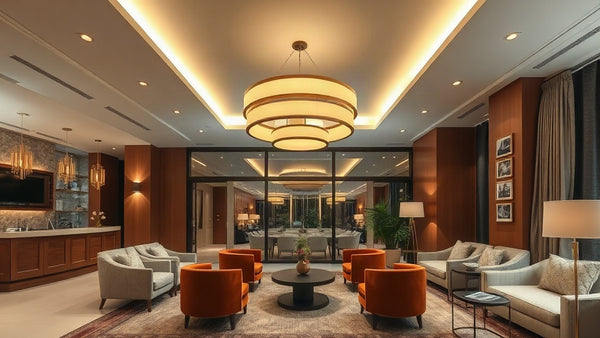
The typical British approach — a ceiling rose with a single fitting — produces what designers call "flat" light. It illuminates everything equally and therefore highlights nothing. Nordic layering works across three levels: diffused pendants at ceiling height, wall sconces at mid-height, and table lamps or candles at floor level. The result is a room that can be modulated — turned up or down — simply by choosing which layers to activate. At Nauradika's wall light collection you'll find sconces designed specifically for this mid-height role.
Lesson 2: Colour Temperature Is Everything
Colour temperature, measured in Kelvin, describes the warmth or coolness of a light source. Daylight at noon runs around 5,500K — blue-white and clinical. Candlelight sits at around 1,800K — deep amber and intensely warm. Most homes benefit from 2,700K to 3,000K: a golden zone that flatters skin tones and creates psychological comfort. In Tromsø, residents overwhelmingly favour the warmest end of this spectrum. Research in environmental psychology backs this up: warm light activates the parasympathetic nervous system (rest-and-digest), while cool light activates alertness. The practical rule is simple: 2,700K for bedrooms and living rooms; avoid anything above 4,000K in domestic spaces.
Lesson 3: The Visible Source
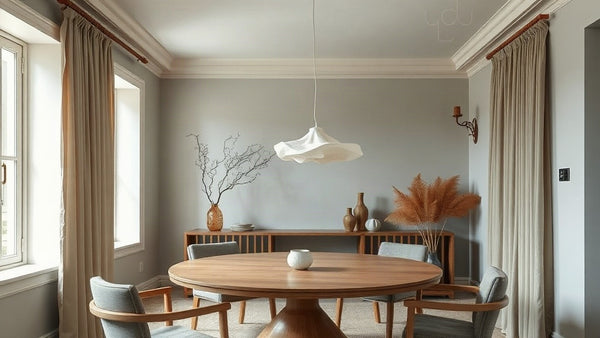
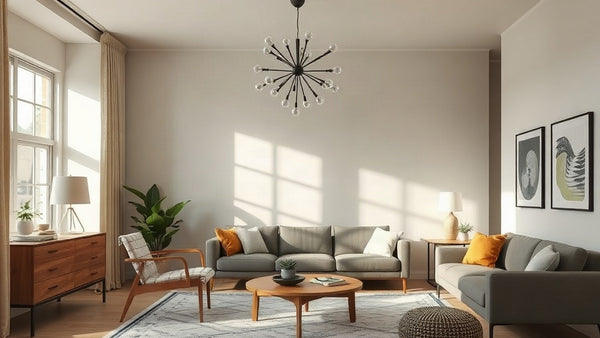
Nordic interiors prefer visible light sources — pendant bulbs, exposed filaments, and decorative lamps whose source is part of the aesthetic. When we see a glowing filament or warm bulb, our brains register warmth and safety. This is why pendant lights remain so central to Nordic design. A beautifully crafted pendant is not just providing illumination — it's creating a focal point and a psychological centre of gravity for the room. Browse Nauradika's pendant collection for designs that work as sculptural objects as well as light sources.
Lesson 4: Koselig — Light as Social Architecture
The Norwegian concept of koselig — cosiness, warmth, and shared presence — describes an atmosphere that must be actively constructed. The tools are consistent: candles on tables and windowsills, low pendants over dining areas, floor lamps in reading corners, and the deliberate dimming of overhead lights after dark. The goal is to compress the social space — to create a pool of warmth that draws people together. The practical lesson is to invest in dimmers on every circuit and think about how your lighting will function at 9pm, not just at noon.
Lesson 5: Windows and Reflection
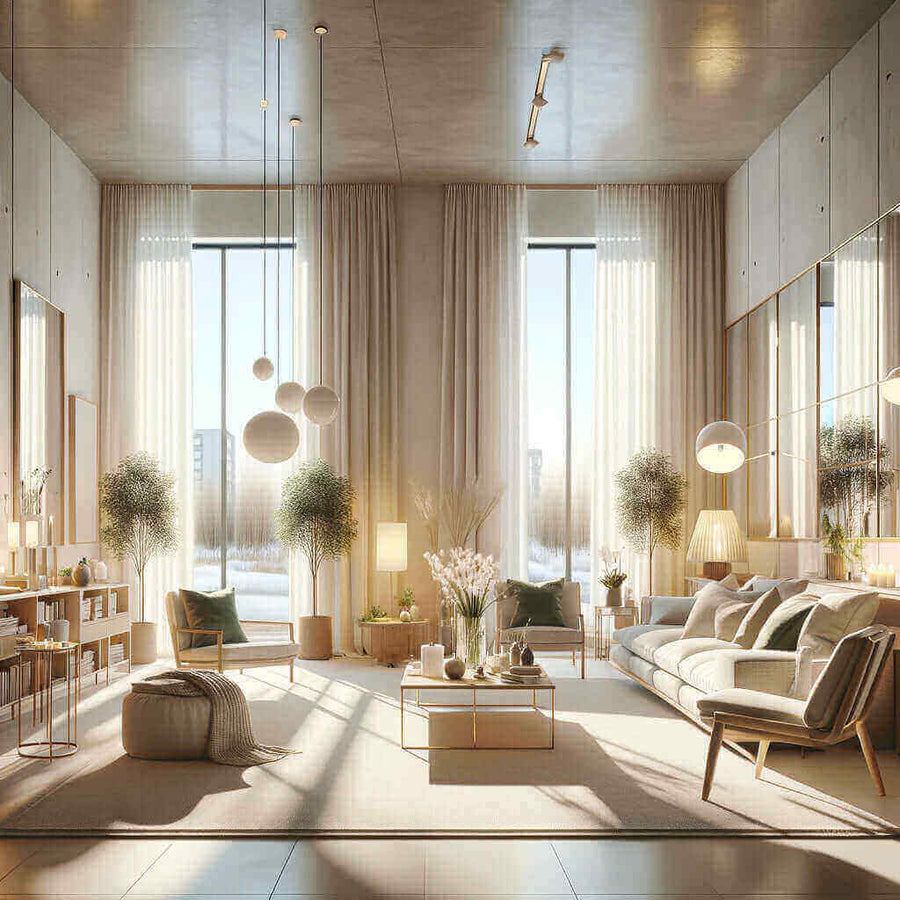
Tromsø residents treat every window as a precious resource. Window treatments are kept minimal or absent entirely — net curtains are essentially unknown in Norwegian domestic interiors. Privacy is managed through furniture placement rather than window coverings. Mirrors and reflective surfaces are used extensively to bounce what little natural light exists deeper into rooms. A large mirror opposite a window can effectively double the perceived brightness of a space — one of the simplest and most impactful changes available to any homeowner.
Bringing Tromsø Home
You don't need to live above the Arctic Circle to benefit from these principles. Start by auditing your current lighting: how many sources do you have in your main living space? Are they layered at different heights? What colour temperature are your bulbs? Do you have dimmers? Most British homes fail on at least three of these criteria — and addressing them doesn't require major renovation, just thoughtful investment in the right fixtures and bulbs. Find the right pieces at Nauradika, London's dedicated lighting specialist.
Nauradika Trade