The Invisible Architecture of Light
Every architect and interior designer understands a principle that often eludes homeowners: the perceived dimensions, proportions, and character of a room are shaped as profoundly by its lighting design as by its physical structure. Light transcends its functional role as a mere illumination tool — it becomes the defining element that establishes spatial identity. Through deliberate choices about light direction, intensity distribution, and colour temperature, you possess the power to fundamentally alter how a space is experienced. A room can appear expansive or intimate, soaring or grounded, welcoming or formal — all achieved through lighting strategy alone, without structural modifications, furniture rearrangement, or decorative interventions.
This principle has deep roots in environmental psychology and architectural practice. The relationship between light and spatial perception operates at a subconscious level, influencing how we move through, inhabit, and emotionally respond to our environments. Understanding these mechanisms empowers you to design spaces that not only function well but feel precisely as intended.
Brightness and Apparent Room Size: The Counterintuitive Truth
One of the most misunderstood aspects of spatial lighting is the relationship between brightness levels and perceived room dimensions. The assumption that "brighter equals larger" is fundamentally flawed. In reality, uniformly high light levels — particularly overhead illumination that bathes every surface in similar intensity — tend to compress spatial perception and emphasise the room's boundaries. When all surfaces are equally visible and equally bright, the eye perceives the room as a defined, enclosed box. The boundaries become visually prominent, and the space reads as smaller and more confined than it actually is.
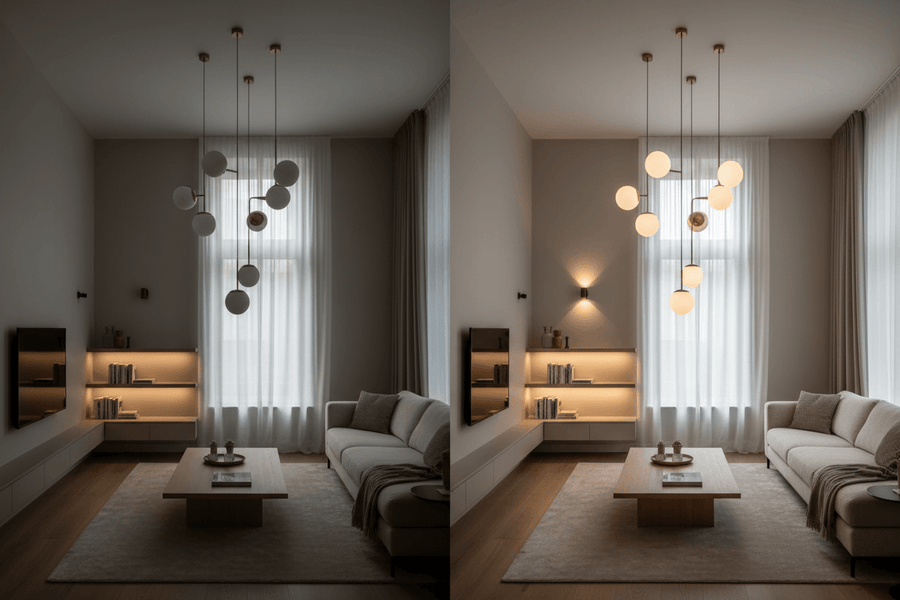
Strategically modulated and directional lighting, by contrast, creates a powerful spatial illusion of expanded dimensions. The technique of wall-washing exemplifies this principle: by directing light across wall surfaces rather than downward from above, you render those walls visually lighter and less solid. Bright, illuminated walls appear to recede into the distance, creating the impression that space continues beyond the actual physical boundary. This effect is particularly valuable in compact rooms where spatial expansion is desired.
The mechanism at work here relates to how the human eye interprets visual information. Dark surfaces appear closer and more enclosing; bright surfaces appear more distant and expansive. By brightening peripheral surfaces — walls, corners, and architectural details — you create visual depth that makes the room feel larger than its square footage suggests. Uplighting floor and table lamps are particularly effective for achieving this wall-washing effect, as they direct light upward and outward to illuminate vertical surfaces rather than concentrating illumination on task areas.
Consider also the principle of layered lighting. Rather than relying on a single overhead fixture, a well-designed scheme incorporates ambient, task, and accent lighting in distinct zones. This layering allows you to brighten certain areas while leaving others in relative shadow, creating visual interest and spatial complexity that uniform illumination cannot achieve. The eye perceives layered, modulated lighting as more sophisticated and spatially richer than flat, uniform brightness.
Ceiling Height and the Perception of Volume
The perceived height of a ceiling is among the most significant factors influencing how a room is spatially experienced. A room with a low ceiling feels oppressive and confined, regardless of floor area; a room with a high ceiling feels expansive and formal, even if it is physically small. Lighting design offers a powerful tool for manipulating this perception without structural intervention.
To create the illusion of a higher ceiling, direct light upward. This can be achieved through several methods:
- Uplighters and wall-mounted fixtures that project light toward the ceiling, causing it to glow with reflected illumination. When a ceiling is visibly lit, it appears to recede and the room seems to extend vertically.
- Pendant fixtures with upward-opening shades that allow light to spill onto the ceiling surface, creating a luminous overhead plane rather than a dark, heavy one.
- Avoiding downward-only fixtures that concentrate all light in the lower zones and leave the ceiling dark and visually heavy.
Conversely, if your goal is to lower the apparent ceiling height and create intimacy in a room that feels uncomfortably tall or formal, employ the opposite strategy. Direct light downward using pendant lights, chandeliers, or recessed downlights that concentrate illumination in the lower and middle zones. Keep the ceiling dark and unlit. This approach makes the ceiling appear closer and more intimate, creating a sense of enclosure and cosiness — particularly valuable in spaces like bedrooms or dining areas where a more grounded, intimate atmosphere is desired.
The psychological effect is significant: a room with an illuminated ceiling feels open and airy; a room with a dark ceiling feels enclosed and intimate. This principle applies across all room types and can be adjusted seasonally or according to the time of day. A bedroom might employ upward-directed lighting during morning hours to energise the space, then transition to downward-directed, warm lighting in the evening to promote relaxation and sleep.
The Critical Role of Shadows in Spatial Definition
Shadows are as essential to spatial perception as light itself — yet they are frequently overlooked in lighting design discussions. Most people focus exclusively on illumination, treating shadows as an unfortunate byproduct rather than a design tool. This represents a fundamental misunderstanding of how spatial perception actually works.
Well-placed shadows create depth, visual richness, and spatial complexity that uniform illumination cannot provide. The principle is straightforward: shadows suggest that space continues beyond the visible, creating an impression of spatial extension. A dark corner in an otherwise well-lit room implies that the room extends into and beyond that corner. This impression of spatial continuation is one of the most powerful tools for making rooms feel larger than their actual dimensions.
Consider the difference between two lighting approaches:
- Uniform overhead lighting eliminates shadows, flattens three-dimensional objects into two-dimensional silhouettes, and creates a visually monotonous environment. The room feels smaller because there is no visual suggestion of space beyond the illuminated area.
- Directional lighting creates shadows on the opposite side of objects from the light source. These shadows create a sense of three-dimensionality, depth, and spatial richness. The eye perceives the shadowed areas as space that extends beyond the immediate focal point.
The most effective spatial lighting schemes employ directional, layered illumination that creates meaningful shadows. This might involve a combination of wall-mounted fixtures, uplighters, and accent lights positioned to create visual depth. The shadows these fixtures create are not defects — they are essential components of the spatial experience.
This principle has particular relevance in open-plan spaces, where the absence of walls makes spatial definition challenging. Strategic shadow placement through directional lighting can create visual zones and implied boundaries, making an open space feel more organised and spatially coherent.
Colour Temperature and Spatial Perception: Beyond Mood
The colour temperature of light — measured in Kelvin (K) — affects not only the mood and atmosphere of a space but also its perceived dimensions. This relationship is grounded in environmental psychology research and has practical implications for spatial design.
Warm light (2,700–3,000K) creates a sense of intimacy and enclosure. Spaces lit with warm light feel smaller, more intimate, and more psychologically comfortable for relaxation and social gathering. The warm tones create a visual compression that makes rooms feel more contained and cosy.
Cool light (4,000K and above) creates a sense of openness and expansion. Spaces lit with cool light feel larger, more formal, and more energised. The cool tones create visual expansion and are associated with clarity, focus, and alertness.
The practical implication is that colour temperature should be selected with both mood and spatial perception in mind. A living room that is physically small but would benefit from feeling intimate and welcoming should employ warm lighting — the spatial compression this creates is a design feature, not a limitation. A bedroom that feels oppressively small might benefit from slightly cooler, brighter light during morning and afternoon hours to create a sense of spaciousness, then transition to warm light in the evening when spatial compression supports relaxation and sleep preparation.
This principle also applies to commercial and professional spaces. Retail environments often employ cool, bright lighting to create a sense of openness and encourage exploration. Office spaces increasingly use adjustable colour temperature lighting to support circadian rhythms and task performance — cooler light during working hours, warmer light in the evening.
When selecting fixtures and bulbs, consider the colour temperature options available. Modern LED technology offers exceptional flexibility, with many fixtures available in multiple colour temperatures or with adjustable colour temperature capabilities. This flexibility allows you to optimise spatial perception for different times of day and different activities within the same space.
Visual Hierarchy and Focal Points: Organising Spatial Perception
A room without visual hierarchy feels spatially undifferentiated and psychologically disorienting. The eye wanders without purpose, unable to find a resting point or understand the spatial organisation. A room with clear visual hierarchy — where lighting draws attention to a primary focal point and organises secondary elements in a supporting role — feels spatially confident, purposeful, and well-designed.
Creating visual hierarchy through lighting does not require excessive overall brightness. Instead, it requires strategic contrast — meaningful differences in light intensity between focal elements and their surroundings. This might involve:
- Accent lighting on artwork, architectural features, or key furniture pieces, creating bright focal points that draw the eye.
- Ambient lighting at lower intensity in surrounding areas, creating visual support without competing for attention.
- Task lighting positioned to illuminate functional areas while maintaining overall spatial coherence.
- Directional fixtures that concentrate light where it is needed, creating visual emphasis through intensity rather than overall brightness.
The psychological effect is significant: spaces with clear visual hierarchy feel organised, intentional, and spatially coherent. The eye knows where to look, the mind understands the spatial organisation, and the overall experience is one of confidence and comfort.
In practice, this might mean using a bright pendant light over a dining table to create a focal point, with dimmer ambient lighting in the surrounding areas. Or it might involve accent lighting on a feature wall or architectural detail, with softer general illumination elsewhere. The key principle is that light intensity should vary meaningfully across the space, creating visual interest and spatial organisation.
Practical Application: Designing for Spatial Perception
Understanding these principles is valuable only if they can be translated into practical design decisions. Here are key considerations for applying spatial lighting principles in your own spaces:
- Assess your space's actual dimensions and desired perception. Is the room physically small but should feel larger? Is it tall but should feel more intimate? Your answers determine your lighting strategy.
- Plan for layered lighting. Avoid relying on a single overhead fixture. Instead, incorporate ambient, task, and accent lighting in distinct zones, allowing flexibility and spatial richness.
- Consider wall and ceiling treatment. Bright walls and ceilings expand perception; dark walls and ceilings compress it. Use this principle intentionally.
- Embrace directional lighting. Position fixtures to create meaningful shadows and visual depth rather than uniform illumination.
- Select colour temperature strategically. Warm light for intimate spaces, cooler light for expansive spaces. Consider adjustable colour temperature for flexibility.
- Create visual hierarchy. Identify focal points and use lighting to emphasise them, creating spatial organisation and visual interest.
Explore Nauradika's wall and pendant light collections to find fixtures that support these spatial design principles. Wall-mounted fixtures are particularly effective for creating directional light and visual hierarchy, while pendant lights offer flexibility for creating focal points and layered illumination schemes.
Conclusion: Light as Spatial Architecture
Light is not merely a functional necessity — it is a design tool of profound power. By understanding how brightness, direction, colour temperature, and shadow affect spatial perception, you gain the ability to fundamentally transform how rooms are experienced. A small room can feel expansive; a tall room can feel intimate; a generic space can become spatially coherent and intentional.
The most sophisticated interior design recognises that space is not defined by walls and dimensions alone, but by how light moves through and defines those physical boundaries. When you design lighting with intention — with an understanding of how light shapes perception rather than simply how it enables vision — you transform not just how rooms look, but how they feel to inhabit. This is the invisible architecture of light, and it is one of the most powerful tools available to anyone seeking to create spaces that are both beautiful and psychologically comfortable.
Nauradika Trade