What Interior Designers Actually Choose for Wall Lighting
When interior designers specify wall lighting for client projects, their criteria differ meaningfully from those of most homeowners. Where homeowners often prioritise aesthetic appeal first, professional designers work through a more structured evaluation: the quality of light produced, the fixture's longevity and maintenance requirements, its compatibility with dimming systems, its proportionality to the space, and only then its visual design. This discipline — thinking about light quality before visual appeal — consistently produces better results.
The First Criterion: Light Quality
Before any visual considerations, professional designers ask: what quality of light does this fixture produce, and is that quality appropriate for this position? For ambient wall lighting, designers look for fixtures that produce diffuse, omnidirectional light — shining both up and down from the wall rather than directing a beam in a single direction. Drum shades, globe shades, and open cylindrical forms typically produce this quality of ambient output. For atmospheric wall lighting, directional fixtures — uplighters, adjustable spots, or shades designed to cast light primarily up or down the wall — create dramatic effects. For reading lights and bedside lamps, adjustability is essential. A swing-arm or articulated wall light that can be directed precisely at a reading position is almost always the professional choice.
Proportion and Scale
The most common wall light mistake in residential interiors is choosing fixtures that are too small for the wall and room they occupy. Professional designers habitually choose wall lights that are confident in their scale — large enough to read clearly in their context. On a large wall plane in a room with high ceilings, wall lights with shade diameters of 25–35cm or more are typically required to read with confidence. In more intimate spaces, smaller fixtures can work, but should still be at the larger end of the range appropriate for that context. Height positioning is equally important: the standard recommendation of approximately 165–175cm from the floor is a reasonable starting point, adjusted for specific context. Bedside lights position lower (135–145cm); hallway lights position higher (180–200cm) for greater drama. Browse Nauradika's wall light collection for well-proportioned options across all scales.
Materials That Endure
Professional designers consistently gravitate toward materials that age well and improve with use. Brass is perhaps the material that best exemplifies this quality — it develops a living patina over time, gradually transitioning from its polished initial state through more mellow, complex tones that most people find more beautiful than the original finish. Unlacquered or living-finish brass requires occasional maintenance but rewards it with a depth and character that lacquered alternatives cannot match. Cast iron, bronze, and hand-forged steel similarly develop character with age. Ceramic fixtures bring organic irregularity and their non-reactive surfaces maintain their appearance indefinitely with minimal maintenance.
Design Families That Designers Return To
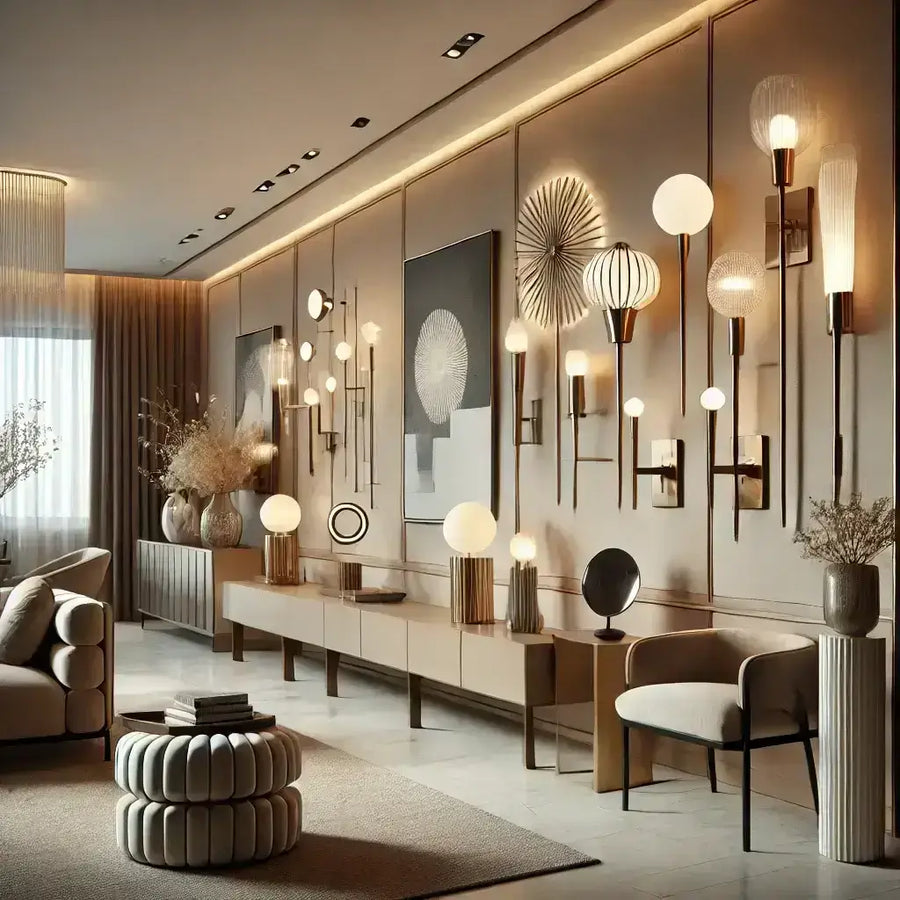
Certain design families prove consistently versatile across different aesthetic contexts. The simple cylinder or drum produces the most versatile light quality of any wall fixture form — diffuse, omnidirectional, and flattering. The articulated reading light — the swing-arm design perfected in the mid-century modern era — remains the professional choice for any position requiring task light from a wall fitting. The architectural uplighter creates dramatic effects by washing wall and ceiling surfaces with warm light, making spaces feel taller and more generous. It works best in pairs or groups, creating a rhythm along a wall plane.
The Pair Principle
Perhaps the most consistent principle in professional wall light specification is the preference for pairs. A single wall light on a wall feels accidental; a matched pair feels designed. The symmetry created by paired sconces — flanking a mirror, a fireplace, an artwork, or creating a balanced rhythm along a wall — is one of the most universally effective compositional tools in interior design. If you're buying a wall light for a new installation, buy two. The difference in how the arrangement reads is almost always worth the additional cost. Find well-matched pairs in Nauradika's wall light range.
Nauradika Trade