Why Lighting Is the Primary Tool for Creating Cosiness
When most people consider how to enhance the comfort and warmth of a living space, their thoughts typically turn to soft furnishings: plush cushions, tactile throws, layered rugs, and upholstered seating. These elements certainly contribute to a room's comfort, but they address only the surface of what creates a genuinely cosy atmosphere. Ask an experienced interior designer or lighting specialist the same question, and the answer will almost invariably begin with lighting. This is not coincidental — it reflects a fundamental truth about how human perception and psychology interact with our physical environment.
Lighting operates at a more foundational level than any furnishing element. It shapes the entire visual and psychological environment of a space, determining not merely what you see but how every other element in the room appears, feels, and is emotionally processed. The relationship is hierarchical: lighting establishes the baseline sensory experience upon which all other design elements build. A room furnished with the finest soft furnishings, elegant furniture, and carefully curated décor will never achieve true cosiness if it is illuminated by harsh, cold light. Conversely, a modestly furnished room with excellent warm lighting will feel welcoming, comfortable, and psychologically safe almost regardless of its other design elements.
This principle is grounded in environmental psychology and human physiology. Light directly influences circadian rhythms, cortisol levels, and the parasympathetic nervous system — the physiological systems responsible for relaxation and comfort. Warm light signals safety and rest; cool light signals alertness and activity. No amount of soft furnishings can override the fundamental physiological response to light quality. Understanding this hierarchy is essential for anyone seeking to create genuinely cosy spaces.
The Three Enemies of Cosiness: What Destroys Comfort
Before exploring what creates cosiness, it is essential to identify and understand what actively destroys it. Three specific lighting characteristics are fundamentally incompatible with cosy atmospheres, and their presence will undermine even the most carefully curated furnishings and décor.
Cool Colour Temperature: The Alerting Effect
Cool colour temperature — light above approximately 3,500 Kelvin — activates the body's alerting and arousal systems. This is physiologically appropriate for workplaces, retail environments, and task-focused spaces where alertness and focus are desired. It is fundamentally inappropriate for spaces intended to feel cosy, intimate, and relaxing.
The mechanism is rooted in human evolution and circadian biology. Cool, blue-enriched light mimics daylight and signals to the body that it is daytime — a time for activity, vigilance, and alertness. Exposure to cool light suppresses melatonin production, elevates cortisol levels, and activates the sympathetic nervous system. These are precisely the opposite of the physiological state cosiness requires.
The practical implication is unambiguous: no room lit primarily in cool-white light will feel genuinely cosy, regardless of how thoughtfully it is otherwise designed or furnished. A living room with cool-white overhead lighting will feel institutional and exposed, even if it contains the finest furniture and soft furnishings. The cool light overrides all other design elements, creating a baseline of alertness that prevents the relaxation and comfort cosiness requires.
Single-Source Overhead Illumination: The Flatness Problem
Single-source overhead illumination — typically a ceiling-mounted fixture providing the room's primary light — produces flat, shadowless light that eliminates the visual depth and richness essential to cosiness. This is perhaps the most common lighting mistake in residential design, and it is particularly damaging to cosy atmospheres.
When light comes from a single overhead source, it illuminates all surfaces at similar intensity and eliminates meaningful shadows. The result is visual flatness — a two-dimensional quality that feels exposed and institutional rather than intimate and comfortable. Cosiness, by contrast, is partly about visual contrast and complexity: the interplay between brightly lit zones and areas resting in pleasant shadow, the visual interest created by directional light and varied illumination levels.
A room lit exclusively by overhead light feels exposed and public — like an office or retail space — rather than sheltered and private. The absence of shadows removes the visual richness that makes a space feel layered and complex. The uniform brightness prevents the creation of intimate zones within the larger space. The result is a room that may be functionally well-lit but is psychologically uncomfortable for relaxation and social gathering.
Excessive Brightness: The Exposure Problem
Excessive brightness — light levels above approximately 150–200 lux in living spaces — prevents the intimate, enclosed feeling that cosiness requires. This is a matter of both absolute light level and relative brightness compared to surrounding areas.
Very bright rooms feel exposed and public rather than sheltered and private. The high light levels eliminate the visual privacy that cosiness provides — the sense of being in a defined, enclosed space separate from the outside world. Bright light also tends to reveal every surface, every imperfection, every detail, creating a sense of exposure rather than comfort. The psychological effect is one of being "on stage" rather than in a private refuge.
This principle applies even to warm-toned light. A room lit at 300 lux with warm light will feel less cosy than the same room lit at 100 lux with the same warm light. The absolute brightness level matters as much as the colour temperature. Cosiness requires a sense of enclosure and privacy, which excessive brightness undermines regardless of other design factors.
The Three Pillars of Cosy Lighting: Creating Comfort Through Design
Having identified what destroys cosiness, we can now explore what creates it. Cosy lighting is built on three consistent, interdependent characteristics: warmth, layering, and focus. Each is essential; together, they create the foundation for genuinely comfortable, intimate spaces.
Pillar One: Warmth — The Colour Temperature Foundation
Warmth in lighting refers to colour temperature — the measure of light's position on the spectrum from cool blue to warm amber. For cosy spaces, colour temperature is the most fundamental design decision.
Cosy lighting requires colour temperatures at or below 2,700 Kelvin — the warm white associated with traditional incandescent bulbs. This temperature range creates psychological associations with safety, comfort, and relaxation. It suppresses alertness and supports the parasympathetic nervous system, the physiological basis of relaxation.
For the cosiest possible atmospheres, even warmer colour temperatures are preferable: 2,200–2,400K produces the deep amber glow of filament LEDs, creating the strongest possible psychological associations with warmth, safety, and intimate comfort. This ultra-warm light mimics the colour of candlelight and firelight — the most ancient and psychologically powerful sources of comfort and safety for humans.
The critical principle is consistency: every bulb in a room intended to feel cosy should be in the warm colour temperature range. A single cool-white bulb in an otherwise warm-lit room creates visual discord and undermines the cosy atmosphere. Consistency of colour temperature across all light sources is essential for creating a unified, psychologically coherent space.
When selecting bulbs and fixtures, verify the colour temperature specification. Modern LED technology offers exceptional flexibility, with warm-toned options available for virtually every fixture type. Avoid the temptation to mix colour temperatures for variety — consistency creates comfort; variation creates visual confusion.
Pillar Two: Layering — Multiple Sources at Different Heights
Layering refers to the use of multiple light sources at different heights and with different visual weights, creating a complex, visually rich lighting environment rather than reliance on a single dominant source.
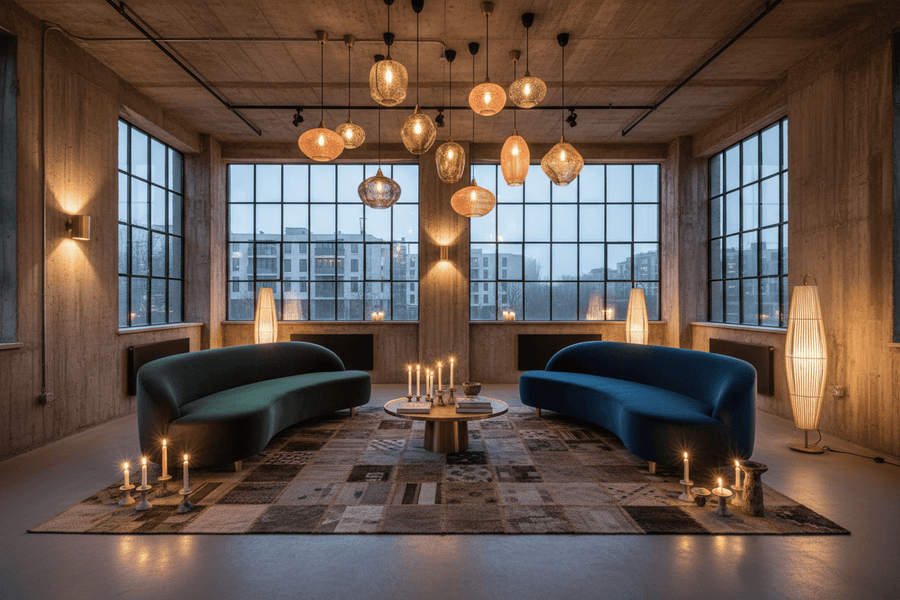
A well-designed cosy living room typically incorporates lighting at four distinct levels:
- Ceiling height: A pendant light or chandelier providing ambient illumination. This should be dimmed to approximately 30–40% of maximum brightness to avoid excessive overall brightness.
- Mid-height (wall-mounted): Wall sconces positioned at approximately 60–70 inches from the floor, providing atmospheric light and visual interest. These create the visual richness and depth that single-source lighting cannot achieve.
- Seating height: Floor lamps positioned beside seating areas, providing reading light and social light. These create pools of warmth that draw people together and define activity zones.
- Low level (table height): Table lamps on side tables, coffee tables, or sideboards, providing the warmest, most intimate light. These create visual interest at the lowest level and contribute to the sense of enclosure.
This four-level approach creates visual complexity and richness that single-source lighting cannot provide. The eye moves through the space, finding visual interest at multiple levels. The interplay of light at different heights creates depth and dimensionality. The multiple sources allow for flexible control — you can adjust the overall atmosphere by dimming or brightening different layers independently.
The practical benefit is significant: a room with layered lighting can transition smoothly from daytime functionality (with multiple layers at moderate brightness) to evening cosiness (with most layers dimmed and only the lowest, warmest sources at full brightness). This flexibility is impossible with single-source lighting.
Explore Nauradika's wall sconce collection for mid-height layering options that provide both functional light and atmospheric warmth. Wall sconces are particularly effective for creating the visual richness and depth that cosy spaces require.
Pillar Three: Focus — Concentrating Light on Activity Zones
Focus means concentrating light where people are and where activities occur, rather than attempting to illuminate the entire room evenly. This principle creates pools of warmth that draw people together and establish intimate zones within larger spaces.
In practice, focus means positioning light sources strategically around areas of activity:
- A floor lamp beside a reading chair, creating a pool of light for comfortable reading and a visual anchor for that seating area.
- A pendant hung low over a coffee table, creating a focal point and defining the social gathering zone.
- Table lamps on either side of a sofa, creating symmetrical pools of light that frame the seating area and provide both functional and atmospheric light.
- Wall sconces flanking a fireplace or artwork, creating visual emphasis and atmospheric light.
The psychological effect is powerful: focused light creates the sense of a "room within a room" — an intimate, defined space within the larger room. This sense of enclosure and definition is central to cosiness. Rather than feeling exposed in a uniformly lit space, you feel sheltered within a defined zone of warmth and light.
Focus also allows for efficiency: you can achieve the desired atmosphere with less total light by concentrating it where it is needed rather than attempting to illuminate the entire space evenly. This contributes to the lower overall brightness levels that cosiness requires.
Specific Fixtures That Create Cosiness: Practical Recommendations
Understanding the principles of cosy lighting is valuable only if they can be translated into specific fixture choices. Certain fixture types are particularly effective at creating cosy atmospheres.
Table Lamps with Fabric Shades: The Quintessential Cosy Fixture
Table lamps with fabric shades are perhaps the most reliable and effective cosy lighting fixtures available. The combination of a warm-toned bulb and a diffusing fabric shade produces exactly the quality of gentle, distributed warm light that cosiness requires.
The mechanism is straightforward: the fabric shade diffuses light, eliminating harsh shadows and creating soft, enveloping illumination. The warm bulb provides the colour temperature foundation. The result is light that feels gentle, welcoming, and psychologically comfortable.
A pair of matching table lamps on a sideboard, or flanking a sofa at end-table height, is one of the most reliable and effective cosiness formulas available. The symmetry creates visual balance; the paired sources create layered light; the low positioning creates focus on the seating area. This arrangement is a design principle that has proven effective for generations and remains one of the most reliable approaches to cosy lighting.
When selecting table lamps, prioritise:
- Fabric shades that diffuse light effectively. Linen, cotton, and silk are all excellent choices. Avoid hard shades that create harsh light.
- Warm colour temperature bulbs — 2,700K or warmer. Verify the bulb specification before purchase.
- Appropriate scale — the lamp should be proportionate to the surface it sits on and the seating area it serves.
- Dimmable bulbs if possible, allowing flexibility in light levels.
Explore Nauradika's floor and table lamp range for options that combine aesthetic appeal with the functional characteristics that create cosiness.
Floor Lamps with Wide Shades: Creating Pools of Warmth
Floor lamps with large, wide shades provide generous ambient light that creates a warm sense of enclosure around a seating area. Unlike table lamps, which are limited by the surface they sit on, floor lamps can be positioned anywhere and can provide more substantial light output.
An arc lamp with a large linen shade positioned over a sofa creates a pool of warm light that defines that area even in an open-plan space. The arc design allows the light to be positioned over the seating area without requiring a table or surface. The large shade diffuses light effectively, creating soft, enveloping illumination.
Floor lamps are particularly valuable in open-plan spaces where wall-mounted fixtures may not be practical. They provide the layering and focus that cosy spaces require while maintaining flexibility — they can be repositioned as needs change.
When selecting floor lamps for cosy spaces, prioritise:
- Large, diffusing shades that create soft light rather than concentrated beams.
- Warm colour temperature — 2,700K or warmer.
- Dimmable capability for flexibility in light levels.
- Appropriate height — the lamp should position light at or slightly above seated eye level, creating comfortable illumination without glare.
Wall Sconces: Mid-Height Atmospheric Light
Wall sconces positioned at mid-height (approximately 60–70 inches from the floor) provide atmospheric light and visual richness that single-source lighting cannot achieve. They are essential for the layering principle and are particularly effective at creating the visual depth and complexity that cosiness requires.
Wall sconces can be positioned symmetrically (flanking a fireplace, artwork, or mirror) or asymmetrically (creating visual interest through varied placement). They provide light at a height that is psychologically comfortable — not overhead (which feels institutional) and not at floor level (which feels insufficient).
The atmospheric quality of wall sconces is particularly valuable. Unlike functional task lighting, sconces are primarily atmospheric — they create mood and visual interest rather than serving a specific functional purpose. This atmospheric quality is central to cosiness.
The Critical Role of Dimmers: Flexibility and Control
Dimmers are not merely a convenience or optional refinement in cosy lighting design — they are essential infrastructure. The ability to reduce light levels to 30–40% of maximum brightness is what allows a room to transition from its daytime functional state to its evening cosy state.
At full brightness, even warm-toned, well-layered lighting can feel too bright and exposed for true cosiness. The absolute light level matters as much as colour temperature and fixture selection. A room at 200 lux feels different from the same room at 80 lux, even with identical fixtures and colour temperature.
Dimmers allow this flexibility. In the morning or afternoon, you might operate all layers at moderate brightness for functional illumination and task performance. In the evening, you can dim the overhead and mid-height layers to 20–30% of maximum, leaving only the lowest, warmest sources at full brightness. This creates a dramatic transformation of atmosphere — the same room becomes progressively more intimate and cosy as light levels decrease.
The psychological effect is significant: the ability to control light levels allows you to match the lighting to your physiological and psychological state. Bright light when you need alertness and focus; dim, warm light when you need relaxation and comfort. This flexibility is impossible without dimmers.
Every circuit in a living room intended for evening relaxation should have a dimmer. This is not optional — it is essential infrastructure for creating genuinely cosy spaces. Modern dimmer technology is reliable, affordable, and compatible with LED bulbs, making installation straightforward.
When installing dimmers, ensure compatibility with your bulbs. Most modern LED bulbs are dimmable, but verification is essential. Avoid cheap dimmers that create flickering or buzzing — quality dimmers operate smoothly and silently across the full range from 0–100%.
Practical Implementation: Creating Cosy Lighting in Your Space
Translating these principles into a functional cosy lighting scheme requires systematic planning. Here is a practical approach:
- Assess your space and activities. Where do people gather? Where do activities occur? What is the room's primary function in the evening?
- Plan for four-level layering. Identify opportunities for ceiling-height, mid-height, seating-height, and table-height light sources.
- Select warm colour temperature fixtures. Verify that every fixture you select is available in 2,700K or warmer. Avoid cool-white options.
- Install dimmers on all circuits. This is essential for flexibility and the ability to transition from functional to cosy lighting.
- Start with table and floor lamps. These are the most flexible and can be added or repositioned as needed. They are also the most cost-effective way to begin implementing cosy lighting principles.
- Add wall sconces for mid-height layering. These require installation but provide essential atmospheric light and visual richness.
- Test and adjust. Cosy lighting is not a fixed formula — it requires adjustment based on your specific space, activities, and preferences. Experiment with different brightness levels and fixture combinations to find what feels right.
The Transformation: From Functional to Cosy
The difference between a room lit for function and a room lit for cosiness is dramatic. The same space, with identical furniture and furnishings, can feel institutional and exposed at full brightness with cool light, or intimate and welcoming when dimmed to 40% brightness with warm light and layered sources.
This transformation is not subtle or marginal — it is fundamental. It affects not just how the room looks but how it feels to be in it. It influences mood, relaxation, social interaction, and psychological comfort. It is the difference between a space you use and a space you enjoy inhabiting.
Lighting is the primary tool for creating this transformation. No amount of cushions, throws, or soft furnishings can compensate for poor lighting. Conversely, excellent lighting can make even modestly furnished spaces feel genuinely cosy and welcoming.
The investment in proper cosy lighting — in warm-toned fixtures, layered sources, and dimmer controls — is one of the most effective investments you can make in your home's comfort and livability. The return on this investment is measured not in financial terms but in the quality of your daily experience: the comfort of your evenings, the pleasure of your social gatherings, the sense of refuge and safety your home provides.
Find everything you need to create genuinely cosy lighting at Nauradika, a specialist in premium lighting design. From table lamps with fabric shades to wall sconces and floor lamps, Nauradika offers the fixtures and expertise needed to transform your space into a genuinely cosy, comfortable environment.
Nauradika Trade