Understanding the Principle of Visual Hierarchy in Interior Design
The concept of a focal point is fundamental to interior design theory and practice. A focal point serves as the primary visual anchor within a space—the element that commands attention first and organises all other design decisions around it. Without a clear focal point, even a well-furnished room can feel disjointed, lacking coherence and intentional composition. The human eye naturally seeks a point of visual rest and interest; when a space fails to provide one, the result is visual fatigue and a sense of incompleteness.
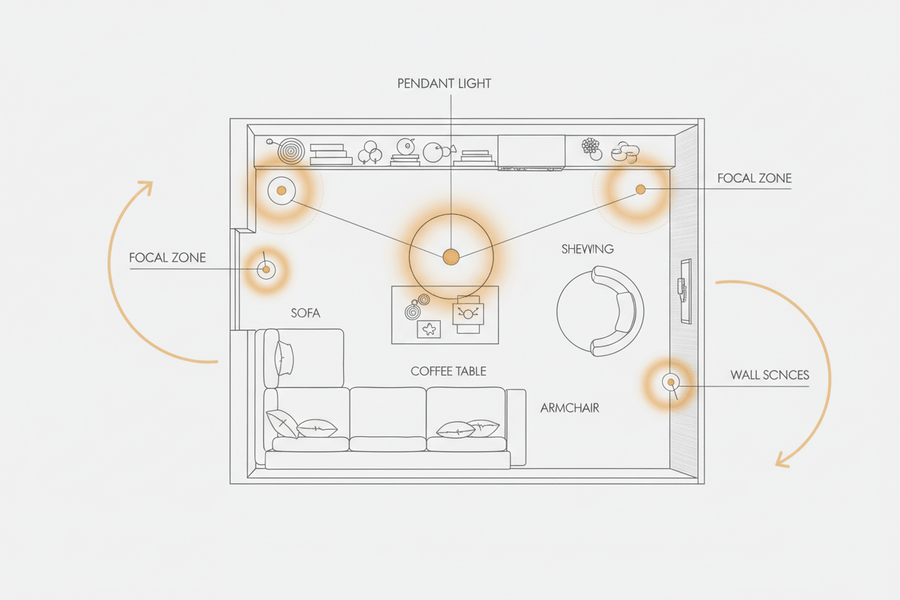
In professional interior design practice, focal points are rarely accidental. They are deliberately constructed through the strategic deployment of colour, scale, texture, and critically, light. Among these tools, lighting stands apart as uniquely powerful because it operates simultaneously on multiple sensory and psychological levels. A well-designed lighting focal point does not merely draw the eye—it creates atmosphere, defines spatial zones, establishes hierarchy, and influences how inhabitants move through and experience a room.
The relationship between lighting and focal point creation is particularly significant because light itself is immaterial yet profoundly visible. Unlike furniture or architectural elements, light cannot be touched, yet it shapes perception more fundamentally than almost any other design element. A strategically positioned light fixture becomes a visual magnet, drawing attention not only to itself but to the area it illuminates, thereby creating a zone of visual and psychological importance.
The Science and Psychology of Focal Point Lighting
Research in environmental psychology demonstrates that humans are naturally drawn to areas of higher illumination. This is partly evolutionary—light has historically signalled safety and opportunity—and partly perceptual. The eye is attracted to brightness contrasts; a brightly lit area within a more dimly lit space will capture attention almost involuntarily. This principle can be leveraged deliberately in interior design to guide attention and structure spatial experience.
When creating a focal point through lighting, several principles should guide your approach:
- Contrast and brightness differential: The focal point should be meaningfully brighter than surrounding areas. A brightness ratio of 3:1 to 5:1 between the focal area and ambient lighting creates a clear visual hierarchy without appearing harsh or unbalanced.
- Directional quality: Focused, directional light is more effective at creating focal points than diffuse, ambient light. Spotlights, pendant lights with downward-facing optics, and wall sconces with controlled beam angles all create stronger focal effects than general overhead illumination.
- Colour temperature alignment: Warmer colour temperatures (2700K–3000K) create a sense of intimacy and draw the eye more effectively than cooler temperatures. This is why traditional incandescent lighting, with its warm output, has long been favoured for focal point applications.
- Scale and proportion: A focal point light fixture must be appropriately scaled to its context. An undersized pendant above a large dining table fails to command attention; an oversized fixture in a modest bedroom overwhelms the space.
Pendant Lighting: The Definitive Dining Focal Point
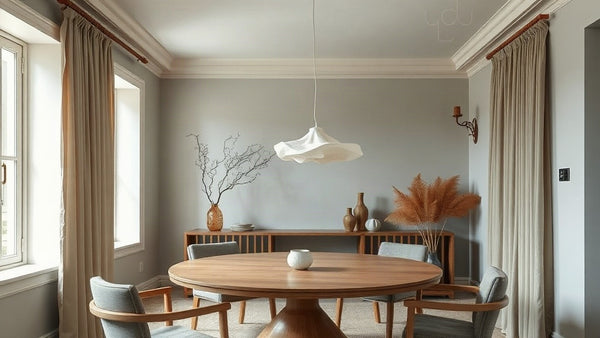
The pendant light suspended above a dining table represents perhaps the most refined and time-tested application of lighting as focal point in residential design. This arrangement has persisted across centuries and design movements because it solves multiple problems simultaneously: it provides task lighting for dining, creates visual interest through the fixture's design, and establishes a clear spatial hierarchy that organises the entire room around the dining function.
The effectiveness of a pendant focal point rests on several technical and aesthetic considerations:
Vertical Axis and Visual Organisation: The pendant creates a vertical line of sight that connects the ceiling plane to the table surface. This vertical axis becomes the room's primary organisational element, pulling the eye downward to the dining surface and upward to the fixture. The result is a composed, intentional spatial arrangement rather than a scattered collection of furniture.
Dimensional Proportions: Professional design practice establishes clear proportional relationships. For round tables, the pendant diameter should approximate 50–60% of the table width. For rectangular tables, the pendant length should be roughly 12 inches shorter than the table length. These proportions ensure visual balance—the fixture appears neither diminished nor overwhelming relative to the surface it serves.
Hanging Height and Sightlines: The bottom of the pendant should typically hang 75–85 centimetres above the table surface. This height achieves two critical objectives: it provides sufficient clearance that diners can maintain eye contact across the table without the fixture obstructing views, and it positions the light source low enough to create an intimate, focused pool of illumination. Hanging too high diminishes the focal effect; hanging too low creates visual obstruction and potential glare.
When selecting a pendant for focal point duty, consider Nauradika's curated pendant collection, which features statement pieces specifically designed to anchor dining and entertaining spaces. The most effective focal point pendants combine visual presence—through distinctive form, material, or finish—with functional lighting performance.
Floor Lamps as Flexible Architectural Anchors
While ceiling-mounted fixtures offer permanence, floor lamps provide unparalleled flexibility in focal point creation. A floor lamp can be repositioned, adjusted, and refined until the spatial balance achieves perfection. This flexibility makes floor lamps invaluable tools for renters, for those undertaking incremental design refinement, and for spaces where ceiling modifications are impractical.
The floor lamp's effectiveness as a focal point derives from its sculptural presence combined with its functional illumination. A tall, architecturally distinctive floor lamp positioned at the end of a sofa, beside a reading chair, or in a room corner creates a visual punctuation mark—a three-dimensional object that commands attention through both form and light output.
Arc Lamps and Spatial Reach: Arc lamps deserve particular attention in focal point applications. The arc lamp's defining characteristic—a curved arm that extends light outward and downward—creates a dynamic spatial relationship. Rather than simply illuminating a fixed point below, the arc lamp appears to reach out and embrace the space beneath it. This creates a sense of intentional spatial organisation; the light actively defines a zone of comfort and activity rather than passively illuminating it.
Sculptural Form and Visual Weight: The most effective floor lamps for focal point duty combine substantial visual presence with refined proportions. A lamp with a distinctive silhouette—whether through an unusual base form, an interesting arm geometry, or a striking shade design—becomes a design object in its own right, worthy of attention independent of its lighting function.
Explore Nauradika's floor and table lamp collection, which includes arc lamps, tripod designs, and sculptural column lamps suitable for focal point applications across diverse interior styles.
Wall Sconces and the Geometry of Symmetrical Focal Points
One of the most enduring focal point formulas in interior design is the symmetrical flanked arrangement: a central architectural or decorative element—a fireplace, mirror, artwork, or built-in shelving—flanked on either side by matching wall sconces. This arrangement has appeared consistently from French baroque interiors through contemporary minimalist spaces, a testament to its fundamental effectiveness.
The power of this arrangement lies in its underlying geometry. Symmetry around a central vertical axis is universally perceived as composed, intentional, and formally resolved. The human eye reads symmetry as a sign of deliberate design rather than chance arrangement. When wall sconces frame a central element, they reinforce its importance through both practical illumination and compositional emphasis.
Positioning and Proportional Relationships: Proper sconce placement is critical to the success of this arrangement. Sconces should be positioned at approximately two-thirds the height of the central element—not at its midpoint, which can appear awkward, and not at its top, which diminishes their framing effect. Horizontally, sconces should be positioned 30–45 centimetres to either side of the central element's edge, creating a balanced but not cramped composition.
Dual Function: Illumination and Composition: Wall sconces in flanked arrangements serve both practical and aesthetic purposes. Functionally, they illuminate the central element, drawing attention to its details and distinguishing it from surrounding surfaces. Compositionally, they frame and reinforce the centrality of the focal element, creating visual order and hierarchy.
For symmetrical focal point arrangements, Nauradika's wall sconce collection offers pairs and matching designs specifically suited to flanking applications, from minimalist contemporary styles to more decorative traditional forms.
Accent Lighting and the Illumination of Existing Focal Points
Not every focal point requires a new light fixture. Many rooms contain existing elements—artworks, architectural features, sculptural objects, or built-in elements—that merit focal point status but lack adequate illumination. In these cases, the design challenge is not to create a new focal point but to illuminate an existing one more effectively.
Accent lighting, also called feature lighting or display lighting, uses directed illumination to distinguish a specific element from its surroundings. This technique is particularly valuable in gallery-like settings, in rooms with significant architectural detail, and in spaces where a particular artwork or object deserves emphasis.
Technical Considerations for Accent Lighting:
- Brightness differential: The illuminated focal element should be 3–5 times brighter than surrounding ambient light. This creates a clear visual hierarchy without appearing theatrical or unbalanced.
- Beam control: Adjustable spotlights on track systems or ceiling-mounted adjustable fixtures allow precise beam direction. The light should illuminate the focal element while minimising spill onto surrounding surfaces.
- Glare management: Accent lighting should enhance visibility of the focal element without creating glare that fatigues the eye or washes out detail. Baffled or recessed fixtures help control glare.
- Colour rendering: High colour rendering index (CRI) lighting—ideally 90 or above—ensures that artworks and objects are rendered with accurate colour and detail.
Bedroom Focal Points: Creating Composed Head-of-Bed Arrangements
Bedrooms present a distinct focal point challenge. Unlike living rooms or dining areas, where focal points organise social activity and entertaining, bedroom focal points must create a sense of calm, privacy, and composed rest. The head-of-bed arrangement is the natural focal point in a bedroom—it is the first element the eye encounters upon entering, and it is the area where occupants spend the most time.
The Symmetrical Bedside Lighting Formula: The classic approach to bedroom focal point lighting employs a pair of matching fixtures—either pendant lights suspended from the ceiling or wall-mounted sconces—positioned symmetrically on either side of the bed. This arrangement creates several benefits:
- Visual balance and composed formality that creates a sense of intentional design
- Practical task lighting for reading without requiring bedside tables
- Flexibility in light control, allowing each side to be dimmed or brightened independently
- Clean aesthetic that maximises usable surface area in the bedroom
Pendant Bedside Lighting: Pendant lights suspended from the ceiling on either side of the bed have become increasingly popular in contemporary bedroom design. This approach offers several advantages over traditional wall-mounted sconces. Ceiling-mounted pendants free valuable wall and surface space, create a cleaner visual aesthetic, and allow for more dramatic or sculptural fixture designs. The key to successful pendant bedside lighting is appropriate scale—the fixtures should be small enough not to overwhelm the intimate bedside space, yet substantial enough to command visual attention and provide adequate task lighting.
Directional Control and Partner Consideration: Bedside lighting must balance task functionality with consideration for a sleeping partner. Directional fixtures that focus light downward onto a reading surface without spilling broadly into the room are essential. Dimmable fixtures allow adjustment of light levels to suit individual preferences and circadian rhythms.
Explore Nauradika's lighting collection for pendant and sconce options suitable for bedroom focal point applications, from minimalist contemporary designs to more decorative styles.
Living Room Focal Points: Beyond the Fireplace
While fireplaces have traditionally served as living room focal points, contemporary living spaces often lack fireplaces or require alternative focal point strategies. Lighting offers flexible solutions for creating visual hierarchy and spatial organisation in living rooms.
A sculptural floor lamp positioned prominently in a living room—perhaps beside a seating area, in a corner, or near a window—can serve as a primary focal point. The lamp's form, combined with its warm light output, creates a zone of visual and psychological importance. This approach is particularly effective in open-plan spaces, where lighting can define distinct functional zones without physical barriers.
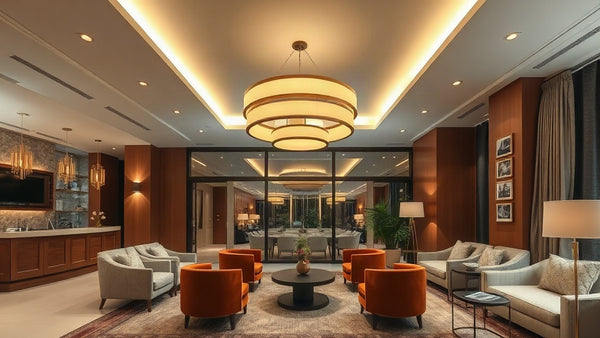
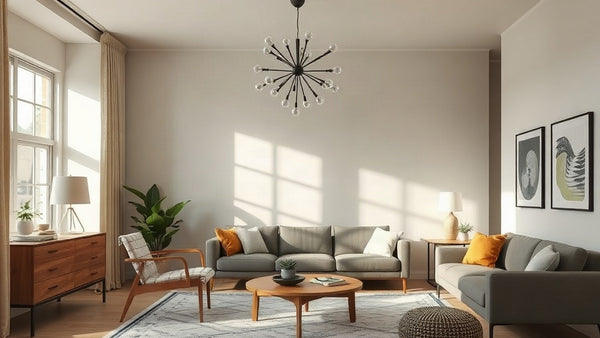
Alternatively, a statement ceiling fixture—a dramatic chandelier, a sculptural pendant cluster, or an architectural ceiling light—can anchor a living room and establish visual hierarchy. The key is ensuring that the fixture's scale and design are appropriate to the room's proportions and aesthetic direction.
Practical Implementation: Creating Your Lighting Focal Point
Step 1: Identify Your Focal Element Determine what should serve as your room's primary focal point. This might be an existing architectural feature, a furniture arrangement, or a new light fixture you plan to introduce.
Step 2: Assess Current Lighting Evaluate your room's existing lighting. Is there adequate ambient illumination? Are there dark corners or areas that lack visual interest? Understanding your baseline lighting conditions helps you determine what focal point lighting strategy will be most effective.
Step 3: Select Appropriate Fixtures Choose lighting fixtures that align with your focal point strategy and interior aesthetic. Consider scale, proportion, colour temperature, and beam characteristics. Nauradika's curated collections offer fixtures specifically selected for their ability to serve as design focal points.
Step 4: Plan Positioning and Height Use the proportional guidelines outlined above to determine optimal fixture placement. For pendants, measure table dimensions and calculate appropriate hanging height. For sconces, establish the central element's dimensions and position flanking fixtures accordingly.
Step 5: Test and Refine If using floor lamps or other moveable fixtures, experiment with positioning before committing to permanent installation. Observe how the light interacts with surrounding surfaces and how it influences spatial perception.
Conclusion: Light as Spatial Organiser
Lighting is far more than a functional necessity in interior design—it is a primary tool for creating visual hierarchy, establishing focal points, and organising spatial experience. A well-designed lighting focal point transforms a room from a collection of disparate elements into a composed, intentional space with clear visual and psychological organisation.
Whether through a dramatic pendant above a dining table, a sculptural floor lamp anchoring a seating area, symmetrical sconces framing a central element, or accent lighting illuminating an existing focal point, strategic lighting design creates rooms that feel finished, purposeful, and beautiful. The most effective interior spaces are those where every element—including light—serves a clear compositional purpose.
Nauradika Trade