The lighting specification meeting is one of the most consistently underestimated conversations in any design project. Clients who have spent months deliberating over kitchen cabinetry, bathroom tile, and flooring finishes will often allocate the lighting budget as an afterthought — a residual line item after everything else has been decided. The result, in project after project, is interiors that are beautifully designed in every respect except the one that determines how every other decision will actually be experienced.
Light is not a finishing touch. It is the medium through which everything else in a room is perceived. The colour of a wall, the grain of a timber floor, the texture of a plaster surface — all of these exist, in the inhabited room, as functions of the light that falls on them. Get the lighting wrong and the room that looked magnificent in the daytime photograph will feel ordinary, or worse, at seven o'clock on a winter evening when the clients are actually living in it.
This guide is written for lighting for architects and interior designers who are specifying on real projects with real budgets — and who want to understand how to achieve exceptional lighting quality without exceptional lighting expenditure. We will cover the current landscape of modern lighting trends, the practical mechanics of sourcing statement pieces at accessible price points, how Nauradika's lighting trade discount programme works, and the emerging application of considered lighting in property staging lighting for sales and lettings.
The current landscape: modern lighting trends in 2026
Understanding the modern lighting trends that are shaping client expectations in 2026 is the starting point for any lighting specification conversation. Three directions are currently dominant, and each has specific implications for specification strategy.
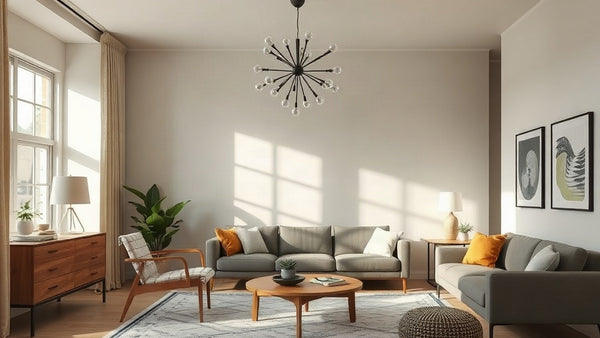
The retro revival: the most significant shift in residential lighting specification over the past three years has been the return of warm, characterful, materially rich lighting forms — mushroom lamps, Italian glass pendants, sputnik chandeliers, saucer ceiling lights. This is not a passing trend; it represents a genuine recalibration of taste away from the cool minimalism that dominated the 2010s and toward something warmer, more expressive, and more historically rooted. Clients who would have specified matte black metal pendants five years ago are now asking for amber glass and organic forms. The design intelligence that drove this — the Italian and Scandinavian studios of the 1960s and 70s — is deep enough to sustain continued interest for years.
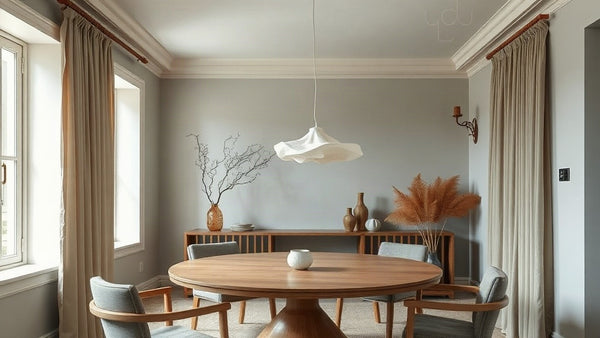
Sculptural and architectural lighting: the second dominant trend is the treatment of lighting fixtures as sculptural objects in their own right — pieces that earn their place in a room in the unlit state as well as the lit state. This is partly driven by the quality of photography in contemporary interiors media, where the lit-versus-unlit visual complexity of a statement pendant is as important as its light output. For specifiers, this means evaluating fittings as objects as well as light sources — asking not just "how does this light the room?" but "how does this read from across the room at midday?"
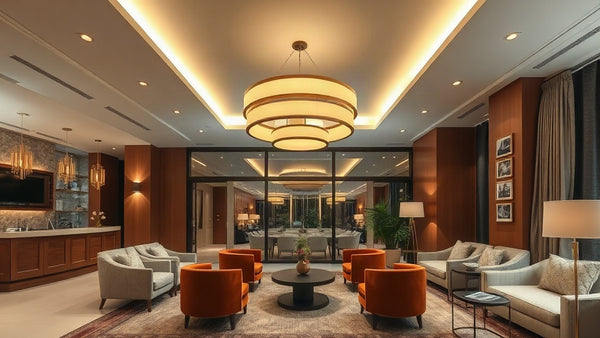
Layered, hygge-influenced lighting: the third trend — discussed in detail in our guide to nordic floor lamps and hygge lighting — is the growing client understanding that good lighting is layered lighting. The single overhead pendant that characterised British residential lighting for decades is increasingly being replaced by schemes that combine ceiling, wall, and floor-level sources on independent dimmer circuits. Clients who have experienced this approach — typically in well-designed hotels or restaurants — are actively asking for it in their own homes.
Sourcing statement pieces at accessible price points
The perception that statement lighting is necessarily expensive is one of the most persistent and most damaging misconceptions in the design industry. It is true that original vintage pieces — a genuine 1970s Vistosi pendant, a first-production Grasshopper floor lamp, an authenticated Panton piece — command significant prices at specialist dealers. But the design intelligence encoded in those pieces is not proprietary. The forms, the material relationships, the light quality that makes them exceptional — all of these can be reproduced in contemporary production at a fraction of the cost, provided the manufacturer is working from a genuine understanding of what makes the original worth referencing.
This is precisely the curation principle behind Nauradika. Every piece in the range is selected on the basis of its fidelity to the design intelligence of the tradition it references — not its fidelity to the specific object. A mushroom lamp that captures the material warmth, the shade geometry, and the light quality of the Italian studio originals, produced at a price that makes it viable for a bedroom in a mid-range residential project, is a more valuable specification tool than an exact reproduction that only works in a luxury context.
For the specifier working across a range of project budgets, this approach has a specific practical implication: the same design language — mid-century modern, Nordic, retro 1970s — can be specified at different price points within a single project. A statement pendant in the entrance hall at the upper end of the budget, mushroom wall lights in the bedrooms at mid-range, and Nordic table lamps in the secondary spaces at accessible prices — the visual language is consistent throughout, but the budget is allocated according to the visual impact of each application.
How the Nauradika lighting trade discount works
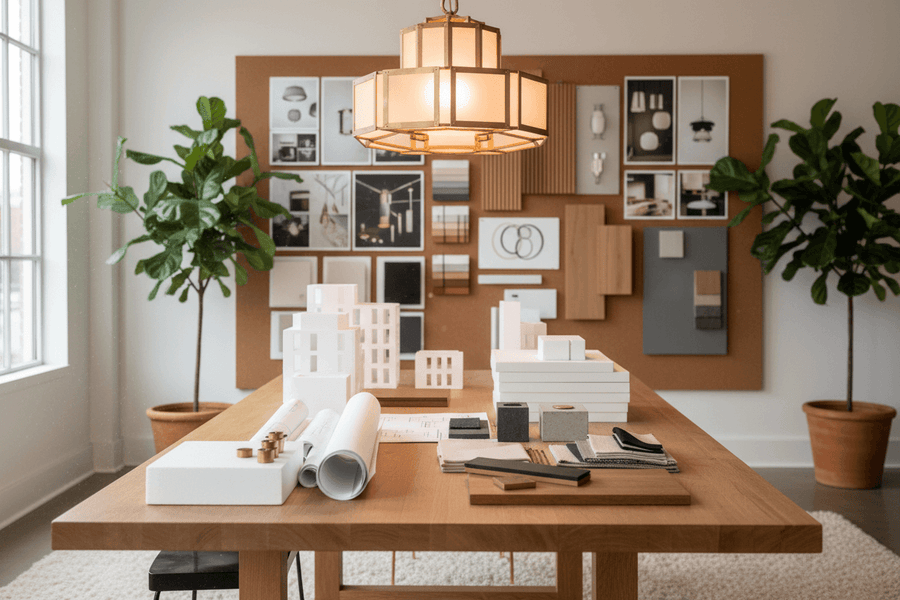
The lighting trade discount at Nauradika is designed for architects, interior designers, property developers, and hospitality specifiers who are purchasing for projects rather than personal use. The programme provides access to trade pricing across the full range, priority handling on project orders, and a dedicated account manager for projects above a defined threshold.
Registration is straightforward — complete the trade account form at nauradika.com/pages/trade-discount with your professional details and project information. Approved accounts receive trade pricing immediately on approval, which typically takes one to two business days.
For larger projects — hotel fit-outs, multi-unit residential developments, commercial refurbishments — we offer project-specific pricing on volume orders. If you are specifying the same fitting across multiple rooms or units, the economies of scale are significant and worth discussing before the specification is finalised. Contact the trade team directly through the trade account page to discuss project requirements.
A note on lead times: the most popular pieces in the Nauradika range — the mushroom lamps, the Italian glass pendants, the sputnik chandeliers — are held in stock for immediate dispatch. For less common pieces, or for volume orders that exceed current stock levels, lead times of two to four weeks apply. For project specifications with a fixed handover date, confirm stock availability and lead times at the point of specification rather than at the point of order.
Property staging lighting: the specification opportunity most designers are missing
The application of considered lighting design to property staging lighting is one of the most consistently underexploited opportunities in the residential design market. The evidence from the property sales and lettings industry is unambiguous: properties that are professionally staged — including lighting — achieve faster sales, higher sale prices, and better quality tenant enquiries than unstaged equivalents. Yet the majority of staging exercises focus on furniture, soft furnishings, and decorative accessories while treating lighting as an afterthought.
The reason this matters specifically for lighting designers and interior designers is that property staging represents a category of work where the brief is unusually clear — make this property photograph well and feel immediately desirable to a target buyer — and where the lighting specification decisions are relatively simple and highly repeatable. A staging lighting scheme does not need to accommodate the long-term lifestyle of the eventual occupant; it needs to make the property look its best in photography and feel warm, welcoming, and aspirational in viewings.
For photography, the key lighting decisions are colour temperature consistency — all sources at 2700K or warmer, to avoid the mixed-temperature colour casts that make property photographs look amateur — and the elimination of dark corners and flat walls through the strategic placement of floor lamps and wall lights. A living room that photographs with three light sources at different heights will consistently outperform one photographed with a single overhead pendant, regardless of the quality of the furniture.
For viewings, the priority shifts to warmth and atmosphere. A property viewed in the evening — which is the majority of viewing appointments — should feel like a home rather than a house. This means lamps on in every room, dimmers at 60–70% rather than full brightness, and the deliberate creation of the kind of layered, warm light that makes a viewer think "I could live here" rather than "this room has adequate lighting."
The floor and table lamp range at Nauradika is well suited to staging applications — the pieces are visually strong enough to contribute to the photography, priced appropriately for a staging budget rather than a permanent specification budget, and available for immediate dispatch for projects with tight timelines. For staging companies working at volume — multiple properties on rotation — a trade account provides the pricing structure and stock priority that makes the economics work.
Building a specification relationship with Nauradika
The most effective specification relationships are built on the designer's confidence that the supplier understands the design language they are working in and can support the full range of their project needs — from a single bedroom pendant to a complete hotel fit-out. At Nauradika, every piece in the range is selected by people who think seriously about design history, material quality, and the practical demands of real projects.
We are not a catalogue supplier. We are a curated range, which means that every piece available through Nauradika has been evaluated against the standards that matter for professional specification: design fidelity, construction quality, light output, material durability, and price point. If a piece does not meet those standards, it is not in the range.
For architects and interior designers specifying across multiple project types and budget levels, this curation is the most valuable thing we offer. You do not need to evaluate every piece from first principles — the curatorial work has been done. You can trust that a Nauradika pendant specified in a residential project, a boutique hotel bedroom, or a restaurant dining room will perform as a piece of considered design rather than simply as a light fitting.
Browse the full Nauradika range at nauradika.com/collections/modern-lighting — and register for a trade account here to access project pricing, priority stock, and dedicated account support for your next project.
Nauradika Trade