Le printemps est la saison du renouveau – et si vous prévoyez une rénovation ou un rafraîchissement de votre intérieur, l'éclairage est l'élément qui change tout. Pas seulement sur le plan fonctionnel, mais aussi esthétique. Le bon éclairage moderne du milieu du siècle ne se contente pas d'illuminer une pièce ; il en devient le point focal, le sujet de conversation, l'élément qui montre que vous avez réfléchi à la manière dont vous souhaitez réellement vivre. Et c'est bien plus facile à réaliser que vous ne le pensez.
Si vous avez parcouru des inspirations de design récemment, vous avez probablement remarqué un regain d'intérêt pour les pièces modernes du milieu du siècle. Il y a eu beaucoup de bruit autour des découvertes d'éclairage moderne du milieu du siècle circulant sur les plateformes de design récemment, avec des collectionneurs et des propriétaires redécouvrant pourquoi les pièces des années 1950 aux années 1970 restent intemporelles et pertinentes. La vérité est que ces designs fonctionnent parce qu'ils résolvent de vrais problèmes – comment éclairer un espace magnifiquement, fonctionnellement, et d'une manière qui ne crie pas "à la mode". Ils chuchotent plutôt.
Pourquoi l'éclairage moderne du milieu du siècle fonctionne en 2026
Il y a quelque chose de rassurant dans le design moderne du milieu du siècle. Il a émergé pendant une période d'optimisme sincère quant à l'avenir, lorsque les designers croyaient qu'une bonne forme devait suivre la fonction, et que de beaux objets devaient être accessibles à tous – pas seulement aux riches. Cette philosophie semble remarquablement actuelle.
L'éclairage moderne du milieu du siècle se caractérise par des lignes épurées, des formes géométriques et une approche honnête des matériaux. Vous verrez du bois de teck et de noyer, des métaux en laiton et en chrome, et des formes en verre sculpturales qui semblent défier leur propre poids. Ces pièces évitent généralement les ornements inutiles ; au lieu de cela, la beauté réside dans la proportion et la qualité des matériaux. Elles sont également remarquablement flexibles. Que votre maison soit une terrasse victorienne, un appartement moderne ou un cottage d'époque, l'éclairage moderne du milieu du siècle s'adapte plutôt que de dominer.
Le véritable avantage ? Ces designs ont déjà prouvé leur longévité. Nous ne nous demandons pas si une suspension moderne du milieu du siècle aura l'air datée dans cinq ans. Nous savons que non, car elle ne l'a pas été au cours des soixante-dix années depuis sa conception.
Comprendre les styles clés de l'éclairage moderne du milieu du siècle
Minimalisme scandinave
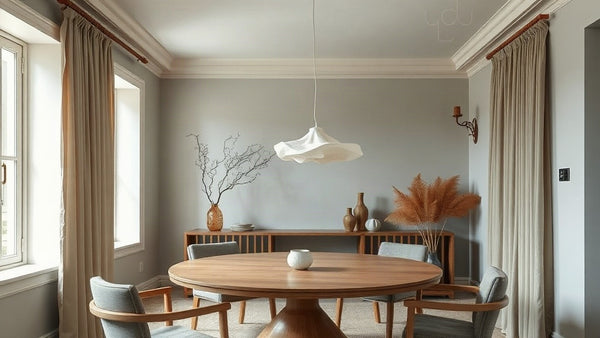
Les designers nordiques ont abordé l'éclairage avec une retenue presque monacale. Pensez à Hans Wegner, Alvar Aalto et Poul Henningsen. Ces pièces privilégient avant tout la fonction et l'honnêteté des matériaux. Une suspension scandinave pourrait n'être rien de plus qu'un abat-jour en papier ultra-mince et un simple raccord en laiton, et pourtant elle crée une atmosphère de sophistication tranquille. Si votre rénovation se dirige vers une élégance calme et discrète, c'est votre voie.
Milieu du siècle américain
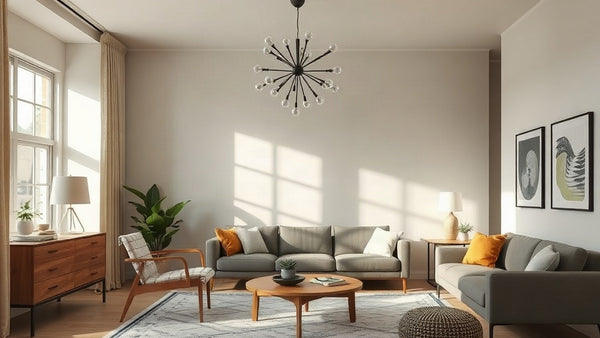
L'interprétation américaine était plus audacieuse. Des designers comme George Nelson et Richard Neutra ont créé des pièces avec une ambition plus sculpturale : des lustres de style sputnik, des lampadaires à trois voies avec des silhouettes en arc, et des suspensions qui ressemblent presque à de l'art abstrait. Il y a de l'optimisme ici, et un peu plus de drame visuel. Cela convient aux maisons qui peuvent accueillir une pièce maîtresse.
Extravagance italienne et scandinave
Les designers en Italie et dans certaines parties de la Scandinavie ont trouvé un juste milieu. Les luminaires modernes du milieu du siècle de cette époque présentaient souvent des couleurs vives, un travail du verre complexe et des accents de laiton qui suggéraient le luxe sans prétention. Les luminaires en verre de Murano, par exemple, sont devenus emblématiques pour leur qualité artisanale et leur richesse visuelle.
Choisir les bonnes pièces pour votre espace
Suspensions : le cheval de bataille
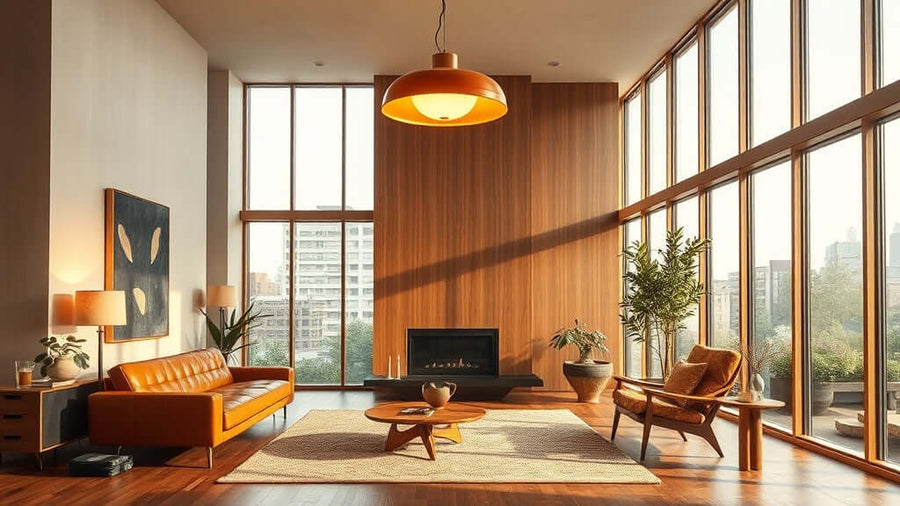
Une suspension moderne du milieu du siècle est peut-être le choix le plus polyvalent pour les rénovations. Que vous redessiniez une cuisine, une salle à manger ou un couloir, une suspension bien choisie offre un éclairage ciblé, un intérêt visuel et une relative facilité d'installation. Recherchez des proportions adaptées à la hauteur de votre plafond et à la taille de la pièce. Une suspension plus petite (diamètre de 20-30 cm) fonctionne à merveille dans les espaces intimes ou regroupée en grappes. Les pièces plus grandes (40-50 cm) conviennent aux pièces spacieuses et agissent comme de véritables points focaux.
Le matériau compte énormément. Une suspension en teck ou en noyer réchauffera une pièce ; le laiton brossé suggère l'élégance ; le verre dépoli diffuse magnifiquement la lumière ; et les abat-jour en céramique ou en porcelaine offrent un attrait sculptural. Considérez où vous voulez que l'œil se porte lorsque quelqu'un entre dans la pièce, et positionnez votre suspension en conséquence.
Lustres : pièces maîtresses
Il y a une idée fausse courante selon laquelle les lustres modernes du milieu du siècle sont des pièces délicates et discrètes. Certains le sont – les élégants luminaires minimalistes en laiton du design scandinave, par exemple. Mais d'autres sont merveilleusement audacieux. Le lustre sputnik, avec son arrangement en étoile de bras et d'ampoules, connaît un certain renouveau auprès des propriétaires qui veulent un véritable point focal sans tomber dans le maximalisme. C'est théâtral sans être kitsch.
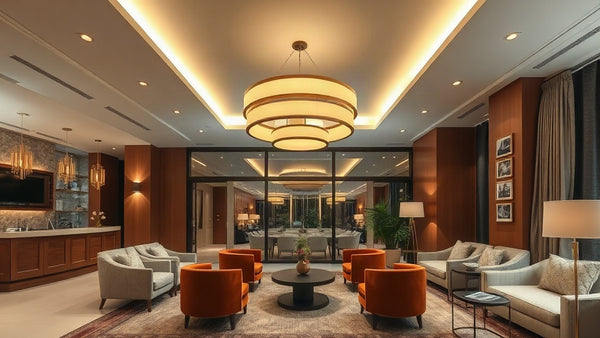
Un lustre MCM fonctionne particulièrement bien dans les halls d'entrée, les salles à manger et les grands espaces de vie. La clé est l'échelle. Un lustre sputnik qui semble parfait dans une salle d'exposition peut submerger une pièce ; inversement, quelque chose de trop modeste ne se justifiera pas comme une pièce maîtresse. Utilisez la hauteur de votre plafond et les dimensions de la pièce comme guide, et n'hésitez pas à essayer quelque chose d'audacieux si les proportions fonctionnent.
Lampadaires : éclairage architectural
Un lampadaire moderne du milieu du siècle est architectural dans son intention. La lampe à arc, développée dans les années 1950, a résolu le problème de l'éclairage d'un coin salon sans rien monter au plafond. Mais elle est devenue emblématique par la beauté de sa réalisation : la courbe de l'arc, le contrepoids, la présence sculpturale. Ces lampes fonctionnent dans les coins, à côté des canapés et dans les coins lecture. Elles sont également portables, ce qui est important si vous aimez ajuster votre espace selon les saisons.
Appliques murales : une élégance sous-estimée
L'éclairage mural moderne du milieu du siècle est souvent négligé, pourtant il est transformateur. Une paire d'appliques en laiton ou en teck flanquant un miroir crée un raffinement digne d'un spa. Des appliques le long d'un couloir établissent un rythme et une chaleur. Contrairement aux luminaires de plafond, les appliques vous permettent d'éclairer un espace sans attirer le regard vers le haut, ce qui maintient le focus sur vos murs, vos meubles et votre art.
Considérations pratiques pour votre rénovation
Ampoules et température de la lumière
La technologie LED moderne est un véritable atout pour l'éclairage moderne du milieu du siècle. Les pièces originales ont été conçues pour des ampoules incandescentes, qui projetaient une lumière chaude et créaient une atmosphère particulière. Les LED blanc chaud d'aujourd'hui (température de couleur de 2700K) reproduisent cette chaleur presque exactement, tout en consommant une fraction de l'énergie et en durant beaucoup plus longtemps. Lors de vos achats, assurez-vous que toute pièce que vous envisagez est compatible avec les ampoules LED dans la température de couleur de votre choix.
Installation et considérations structurelles
Certains éclairages modernes du milieu du siècle nécessitent un câblage fixe ; d'autres sont enfichables (notamment les lampadaires et les lampes de table). Si vous êtes en pleine rénovation, il est utile de planifier les points électriques en fonction de votre plan d'éclairage plutôt que de les installer après coup. Une consultation avec votre électricien pour déterminer l'emplacement des suspensions et des appliques, et le poids qu'elles devront supporter, est un temps bien dépensé.
Réalité budgétaire
L'éclairage authentique du milieu du siècle, c'est-à-dire les pièces de l'époque d'origine, représente un investissement important. Cependant, les fabricants contemporains ont magistralement reproduit l'esthétique à des prix abordables. La différence entre un lustre en verre de Murano original des années 1960 (des milliers de livres) et une reproduction fidèle (des centaines) est marginale en termes d'impact visuel et de durabilité, bien que l'histoire et la provenance diffèrent. Les deux sont des choix légitimes en fonction de votre budget de rénovation et de votre philosophie.
Pour ceux qui envisagent l'éclairage moderne du milieu du siècle dans le cadre d'un projet de rénovation plus vaste, l'exploration d'un programme de remise professionnelle Nauradika peut générer des économies significatives sur plusieurs pièces.
Concevoir votre schéma d'éclairage moderne du milieu du siècle
Les rénovations les plus réussies traitent l'éclairage comme un système en couches plutôt que comme une décision unique. Vous pouvez combiner une suspension audacieuse dans la salle à manger, des appliques murales ambiantes dans le couloir, un lampadaire sculptural dans le coin du salon et des lampes de table minimalistes sur les tables d'appoint. Chaque pièce doit sembler intentionnelle plutôt qu'aléatoire.
Considérez la palette existante de votre pièce. L'éclairage moderne du milieu du siècle en laiton se marie magnifiquement avec les tons de bois chauds et les tissus d'ameublement aux couleurs terreuses. Le chrome et le verre dépoli conviennent aux schémas plus froids et plus contemporains. Les céramiques sculpturales ou le verre coloré s'accordent bien avec les murs neutres et permettent à l'éclairage lui-même d'apporter un intérêt visuel.
Il y a aussi quelque chose de profondément satisfaisant à s'engager dans une philosophie d'éclairage. Plutôt que de mélanger des suspensions modernes du milieu du siècle avec des rails d'éclairage contemporains et des luminaires industriels, une approche cohérente – même si toutes vos pièces ne proviennent pas exactement de la même époque ou de la même région – crée une harmonie visuelle.
Où commencer votre recherche
La saison de rénovation du printemps signifie que la demande est élevée et que les meilleures pièces partent rapidement. Commencez par identifier les pièces qui comptent le plus. Est-ce la cuisine, où vous passez vos matinées ? La salle à manger pour les réceptions du soir ? Votre chambre pour la lumière du matin ? Prioriser ces espaces vous assure d'investir de manière réfléchie plutôt que réactive.
Une fois vos priorités établies, commencez à recueillir des références visuelles. Enregistrez des images d'éclairage moderne du milieu du siècle qui vous plaisent, notez les matériaux et les styles, et commencez à reconnaître ce qui vous attire vraiment plutôt que ce qui, selon vous, devrait vous attirer. Ce processus clarifie remarquablement rapidement votre direction esthétique.
Enfin, ne sous-estimez pas la joie de trouver la bonne pièce. Il y a un réel plaisir à découvrir un luminaire moderne du milieu du siècle qui semble parfaitement adapté à votre espace — ce moment où la fonction, la forme et votre goût personnel s'alignent complètement. C'est ce qu'offre un bon design, qu'il soit original ou fidèlement reproduit : la satisfaction de vivre magnifiquement.
Ce printemps, alors que vous rénovez et rafraîchissez, n'oubliez pas que l'éclairage est rarement une idée de dernière minute dans les pièces qui vous semblent vraiment bien. Investissez dans des pièces que vous aimez sincèrement, privilégiez la qualité et la proportion, et votre espace vous le rendra pendant des années.
Nauradika Trade