Les appliques murales comme intention de conception : Un cadre de spécification
Les appliques murales occupent une position particulière dans les spécifications architecturales. Elles ne sont ni un pur éclairage de tâche ni entièrement ambiantes – ce sont des modificateurs spatiaux, des créateurs d'ombres et des pièces maîtresses. Lorsque vous spécifiez des appliques murales pour un projet résidentiel ou commercial, vous ne sélectionnez pas simplement un luminaire ; vous établissez un rythme visuel, contrôlez le comportement de la lumière au niveau des yeux et déterminez si un espace semble intime ou expansif.
Ce guide aborde les considérations pratiques et esthétiques dont les architectes ont besoin lors de la spécification d'appliques murales, avec une attention particulière aux précédents du milieu du siècle et scandinaves qui continuent d'influencer le design intérieur contemporain. Nous irons au-delà des préférences esthétiques pour aborder les domaines de la capacité de charge, de l'accès pour l'entretien et de l'intégration avec les surfaces architecturales.
Comprendre les catégories d'appliques murales et les exigences de performance
Spécification des appliques murales pour tâche ou ambiance
Le premier point de décision sépare l'intention fonctionnelle de l'intention décorative. Une applique murale spécifique à une tâche – lampe de lecture à côté d'un lit, éclairage d'accentuation dans un environnement de vente au détail – fonctionne selon des exigences de lux définies. Un minimum de 40 à 60 lux est standard pour les applications de lecture ; les appliques murales ambiantes visent généralement 20 à 40 lux au niveau du visage, bien que cela varie considérablement en fonction de la lumière du jour ambiante et des schémas d'éclairage supplémentaires.
Le design des appliques murales scandinaves fait historiquement le pont entre ces deux approches. De nombreux designers nordiques ont rejeté la fausse frontière entre le fonctionnel et le beau, produisant des luminaires qui fonctionnent adéquatement comme éclairage de tâche tout en conservant une présence sculpturale. Cela reste pertinent lors de la spécification pour des projets hôteliers ou résidentiels où l'éclairage ne doit pas annoncer sa fonction.
Les appliques murales ambiantes dans les schémas axés sur l'été bénéficient de températures de couleur chaudes (2700K–3000K) qui ne concurrencent pas le gain de lumière du jour. Des sorties plus froides (4000K) fonctionnent lorsque les appliques complètent une lumière naturelle insuffisante ou servent principalement à des fonctions nocturnes.
Surface de montage et considérations structurelles
La spécification des appliques murales commence par une évaluation honnête de votre surface intérieure. Le placoplâtre, la maçonnerie solide, le bois ou les matériaux composites nécessitent chacun des stratégies de fixation différentes. Une applique murale du milieu du siècle pesant 2 à 3 kg exige un ancrage sécurisé ; les pièces sculpturales plus lourdes (4 à 6 kg) peuvent nécessiter un blocage en bois à l'intérieur de la cavité murale pendant la documentation de construction.
La plupart des appliques murales de qualité se montent via une seule plaque arrière, généralement de 100 à 150 mm de diamètre. Cet encombrement est important pour la planification spatiale – les positions doivent dégager les cadres de porte, les fenêtres et les détails architecturaux d'un minimum de 150 mm. La spécification de hauteur pour les appliques montées par paires flanquant un mur d'accent doit maintenir une symétrie visuelle ; 1500 à 1650 mm du sol au centre du luminaire reste la norme pour les chambres et les applications hôtelières.
Dans les projets commerciaux, spécifiez les matériaux de la plaque arrière pour qu'ils correspondent aux finitions adjacentes. Les options en acier inoxydable, en acier thermolaqué ou en placage de bois évitent la discontinuité visuelle. Documentez clairement les spécifications de finition – mat ou poli, codes de couleur et attentes de patine pour les composants en bronze ou en laiton vieilli.
Sélection des matériaux et durabilité dans la spécification des appliques
La logique derrière les choix de matériaux nordiques
Le design des appliques murales scandinaves privilégie des matériaux durables et honnêtes : des cadres en bois massif, du verre soufflé à la bouche, du métal thermolaqué ou brut. Il ne s'agit pas d'un purisme esthétique – ces matériaux fonctionnent de manière fiable dans les environnements résidentiels et commerciaux sur une durée de vie de plus de 10 ans.
Les appliques murales nordiques en bois offrent des propriétés acoustiques naturelles ainsi qu'une chaleur visuelle, particulièrement appréciées dans les intérieurs d'hôtellerie où les surfaces dures dominent. Le chêne, le noyer et le frêne teinté blanc sont des standards ; spécifiez les traitements de finition pour les environnements humides (cuisines, salles de bains). Les finitions laquées protègent contre l'humidité ; les finitions à l'huile naturelle nécessitent des cycles d'entretien de 12 à 24 mois.
Les composants en verre des appliques murales bénéficient des spécifications de borosilicate ou de verre sodocalcique. Le verre soufflé à la bouche ou coulé à la main introduit des variations acceptables – votre spécification devrait l'accepter plutôt que d'exiger l'uniformité. Clarifiez si le verre dépoli, clair ou teinté s'aligne avec votre stratégie de couleurs intérieures.
Intérieurs d'été et translucidité
La tendance de design 2026 vers un éclairage coloré pastel prend une pertinence particulière dans les schémas axés sur l'été. Plutôt que des blancs neutres, envisagez des blancs chauds doux (2200K–2700K) associés à des diffuseurs en verre translucide ou dépoli dans des tons crème pâle, gris doux ou blush à peine teinté. Ceux-ci créent une lumière ambiante sans la qualité clinique du blanc chaud standard.
La transparence des matériaux devient un langage de spécification : distinguez entre diffus (lumière dispersée, pas d'éblouissement, luminance réduite), semi-transparent (visibilité partielle de la source, éblouissement adouci) et clair (vue directe de l'ampoule). Associez cela au type de lampe (filament LED pour l'intérêt visuel, LED standard pour l'efficacité) et au contrôle de gradation pour permettre un ajustement saisonnier de la lumière.
Intégration avec les systèmes architecturaux
Infrastructure électrique et de contrôle
Les circuits d'appliques murales nécessitent une considération individuelle plutôt qu'un chaînage avec les luminaires de plafond. Spécifiez des circuits dédiés lorsque c'est possible, en particulier pour les applications à intensité variable. Les rénovations LED ont modifié la compatibilité de la gradation – tous les drivers LED ne graduent pas avec les gradateurs à coupure de fin de phase standard. Documentez le type de gradateur (à coupure de début de phase, à coupure de fin de phase, 0–10V) dans vos schémas électriques.
Pour les applications commerciales impliquant plusieurs groupes d'appliques, étudiez les capacités de création de scènes. Les systèmes de gestion de bâtiment s'attendent de plus en plus à un contrôle groupé des appliques murales sans nécessiter de commutation de relais individuelle. Les protocoles DALI ou DMX offrent une flexibilité ; spécifiez l'architecture de contrôle avant la sélection des luminaires pour éviter les frictions de compatibilité.
Les panneaux d'accès et les voies de maintenance doivent dégager les positions des appliques d'un minimum de 300 mm. Dans les projets de rénovation, évitez de placer les appliques directement au-dessus des radiateurs ou là où les courants thermiques accéléreront l'accumulation de poussière sur les composants en verre.
Association des appliques avec les détails architecturaux
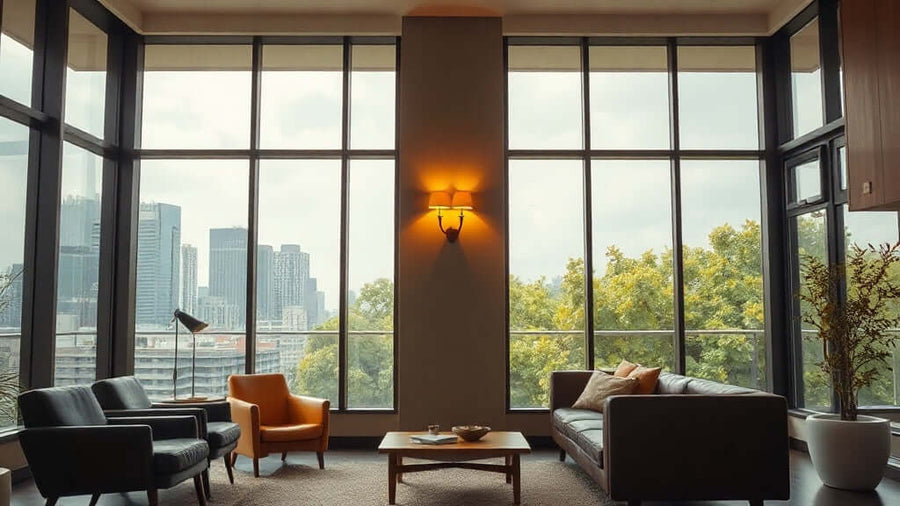
Les appliques murales fonctionnent de manière optimale lorsqu'elles répondent au rythme architectural existant. Le positionnement des appliques pour encadrer les portes, les alcôves ou les murs d'accentuation crée une intentionnalité. Dans les espaces résidentiels ouverts, les paires d'appliques ancrent souvent les zones de sièges plus efficacement que l'éclairage ambiant au plafond.
Considérez l'interaction avec d'autres matériaux. Une applique montée à côté d'un revêtement en bois, de la pierre ou d'un papier peint à motifs doit tenir compte de la réflectivité de ce matériau. Les surfaces mates absorbent la lumière (réduisant le déversement, créant un modelage d'ombres) ; les surfaces polies ou réfléchissantes renvoient la lumière (augmentant la luminance perçue, créant un risque d'éblouissement dans certaines géométries).
Cadre de spécification et de sélection des produits
Évaluation de la qualité des appliques murales modernes du milieu du siècle
Lors de la spécification d'appliques murales modernes du milieu du siècle, l'authentification est moins importante que la compréhension du langage de conception et de la qualité de fabrication. Les pièces authentiques des années 1950-1970 fournissent rarement un éclairage adéquat pour une utilisation contemporaine ; les rééditions modernes conçues avec l'intégration LED offrent de meilleures performances tout en maintenant l'intégrité visuelle.
Examinez l'ingénierie de la plaque arrière. Le système de montage répartit-il la charge sur plusieurs fixations ? L'entrée électrique est-elle protégée par des indices IP adaptés à votre environnement (IP44 minimum pour les cuisines, salles de bains ; IP20 acceptable pour les intérieurs secs) ? Vérifiez la disponibilité des pièces de rechange – les diffuseurs, les joints et les transformateurs devraient être disponibles dans un délai de 6 semaines.
Les appliques murales dans les applications commerciales bénéficient de produits avec des garanties étendues (5 à 10 ans sur les composants, en particulier les modules LED coûteux). Vérifiez la disponibilité des drivers de remplacement ; de nombreux fournisseurs cessent la production de produits dans un délai de 3 à 5 ans, ce qui crée des problèmes de maintenance.
Exploration de la gamme complète
La collection complète d'appliques murales et de luminaires muraux chez les détaillants spécialisés dans le design moderne du milieu du siècle et scandinave révèle la taxonomie des options contemporaines. Vous rencontrerez plusieurs formes archétypales :
- Appliques à bras pivotant : Bras articulés permettant un ajustement directionnel, précieux pour les applications de lecture et l'éclairage de tâche flexible. Spécifiez la longueur du bras en fonction des exigences de projection.
- Appliques encastrées : Petites plaques arrière avec projection minimale (80–120 mm), essentielles pour les couloirs étroits ou les contraintes spatiales.
- Appliques à diffuseur en verre : Formes sculpturales ou géométriques en verre offrant une lumière ambiante avec un éblouissement réduit. Vérifiez l'accès pour le nettoyage dans les notes de spécification.
- Appliques à cadre en bois : Propriétés acoustiques et visuelles intégrées, particulièrement précieuses dans la conception hôtelière. Spécifiez l'essence de bois, la finition et les exigences d'entretien.
- Appliques murales directionnelles : Spots et éclairages d'accentuation créant des ombres spectaculaires et mettant en valeur des éléments architecturaux. Spécifiez l'angle du faisceau (généralement 20°–60°) et la température de couleur.
Documents de spécification et communication de projet
Normes de calendrier et de notation
La spécification des appliques murales suit la pratique standard de documentation architecturale. Dans les tableaux de luminaires, incluez : la désignation du luminaire (W1, W2, etc.), l'emplacement, le type d'ampoule, la température de couleur, la capacité de gradation, la finition, la quantité et le fournisseur. Référéncez-vous aux plans électriques montrant le routage des circuits et les points de contrôle.
La notation sur les plans d'étage doit indiquer les emplacements des appliques avec l'orientation de la boussole lorsque la directionnalité est importante. Les détails de section clarifient les hauteurs de montage et les relations spatiales avec les éléments adjacents – particulièrement important lorsque les appliques encadrent des caractéristiques architecturales ou se rapportent à la menuiserie.
Pour la documentation des intentions de conception, incluez des références photographiques de projets précédents. Cela communique les objectifs spatiaux et atmosphériques plus efficacement que la seule spécification. Si un client demande des "appliques murales modernes du milieu du siècle", différentes interprétations existent ; la référence visuelle élimine l'ambiguïté.
Coordination avec le design intérieur et l'ingénierie
Le placement des appliques murales nécessite une coordination entre les disciplines. Les éléments structurels peuvent interdire les emplacements préférés ; la distribution électrique peut nécessiter des positions de compromis. Établissez les emplacements préliminaires des appliques pendant la conception schématique, puis confirmez la faisabilité pendant le développement de la conception lorsque la coordination MEP devient détaillée.
Les projets commerciaux impliquant plusieurs types d'appliques bénéficient de maquettes ou d'installations d'échantillons. Le montage d'échantillons de luminaires candidats sur des surfaces intérieures représentatives permet d'évaluer l'interaction de la température de couleur, la distribution de la lumière et l'impact spatial avant la spécification finale.
Tarification professionnelle et économie de projet
Alignement budgétaire et ingénierie de la valeur
Les appliques murales de style Mid-Century Modern et scandinave existent dans une large gamme de prix. Les pièces contemporaines d'entrée de gamme inspirées des formes classiques coûtent entre 40 et 100 £ ; les rééditions de designers ou les luminaires en production limitée peuvent atteindre 200 à 500 £ et plus. Spécifiez en fonction du budget du projet et des exigences de durabilité plutôt que de rechercher une marque prestigieuse.
Pour les projets multi-unités ou à grande échelle, négociez les prix de gros. La plupart des fournisseurs, y compris Nauradika, offrent des remises professionnelles sur les commandes groupées. Le programme de remise professionnelle Nauradika propose une tarification échelonnée pour les architectes et les designers qui spécifient plusieurs luminaires pour plusieurs projets, rendant possible la sélection de luminaires compétitifs en termes de coûts sans sacrifier l'intention de conception.
Calculez le coût total de possession, pas seulement le prix du luminaire. Les luminaires à LED intégrées éliminent les coûts de remplacement continu des lampes, mais peuvent entraîner un coût initial plus élevé. Les options dimmables coûtent 15 à 30 % de plus que les équivalents à sortie fixe ; justifiez cet investissement en fonction des exigences de contrôle et de la flexibilité énergétique.
Conclusion : La spécification comme langage de conception
La spécification des appliques murales représente une prise de décision spatiale et expérientielle. Vous ne sélectionnez pas des objets décoratifs ; vous établissez la manière dont la lumière atteint le niveau des yeux, dont les ombres modèlent les surfaces et dont les occupants perçoivent la proportion et l'intimité spatiales.
L'attrait durable des appliques murales modernes du milieu du siècle et scandinaves réside dans leur résistance à l'obsolescence. Ces designs fonctionnent avec la technologie d'éclairage contemporaine, répondent de manière authentique à l'expression matérielle et maintiennent leur intégrité visuelle au fil des décennies. Lorsque vous spécifiez de manière réfléchie – en tenant compte de la faisabilité structurelle, de l'intégration électrique, de la durabilité des matériaux et du contexte spatial – les appliques murales deviennent des investissements dans la cohérence architecturale plutôt que de simples gestes stylistiques.
Commencez la spécification des appliques tôt, coordonnez rigoureusement entre les disciplines et documentez clairement. La différence entre une conception d'éclairage intégrée réussie et des décisions de rénovation regrettables provient souvent de la précision de la spécification pendant le développement de la conception.
Nauradika Trade