Hotel lighting has evolved dramatically. Where once it was treated as functional infrastructure, it's now recognised as a critical design gesture that shapes guest experience, operational efficiency, and brand identity. If you're specifying for a hospitality project—whether a luxury boutique hotel, contemporary restaurant, or corporate accommodation wing—the lighting strategy demands the same rigour you'd apply to structural systems.
This guide addresses the specification challenges specific to hospitality environments: layered illumination for shifting use cases, durability under intensive schedules, maintenance accessibility, and the increasingly non-negotiable demand for human-centric lighting that supports circadian rhythms.
Understanding the Three-Layer Hierarchy in Hotel Lighting
Effective hotel lighting operates across three distinct but integrated layers. Unlike residential design, where you might collapse these, hospitality demands architectural clarity.
Ambient Base Layer
This is your foundation. In guest rooms, you're aiming for 150–300 lux at desk level during evening hours, dropping to 50–100 lux for circulation and comfort. The recent Lumenture Lighting Trends in 2026 report highlighted a significant shift toward warm colour temperature (2700K or lower) as standard across hospitality lighting, moving away from the clinical 4000K that dominated previous specifications.
For corridor and public spaces, maintain 300–500 lux, but distribute it to avoid the institutional glare that characterized older hotel designs. Recessed downlighting remains common, but layered with surface-mounted or pendant elements to soften uniformity. The Scandinavian approach—multiple lower-output sources rather than fewer bright ones—is now industry standard for hospitality lighting because it reduces eye strain and improves perceived spaciousness.
Task Layer
Restaurant lighting and task-focused hospitality spaces require precise specification. Desk lighting in business-oriented hotels should deliver 500 lux minimum at work plane, with colour rendering index (CRI) ≥90. Avoid blue-enriched wavelengths after 8 PM if the space is used for relaxation.
Dining environments are more nuanced. Fine dining benefits from 200–300 lux with warm temperature (2700K), directed to avoid table glare while defining the space vertically. Casual restaurant lighting can run warmer (50–100 lux ambient with localized accent), creating intimacy without compromising staff ability to navigate service routes safely.
Accent/Sculptural Layer
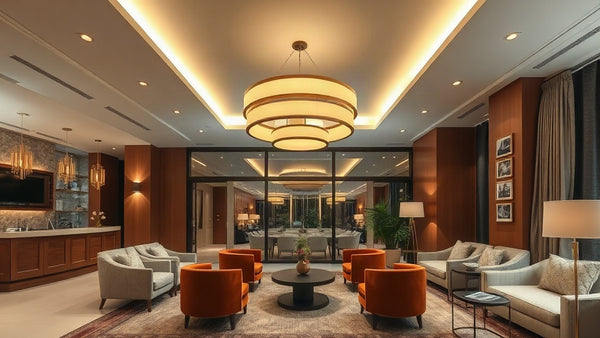
This is where hotel lighting transcends function and becomes design statement. Feature pendants, wall sconces, and sculptural forms create visual interest and reinforce brand narrative. The luxury hotel tubular golden LED chandelier exemplifies this category: it reads as a significant design object while delivering practical illumination. In reception areas, lobbies, and dining spaces, your accent layer should account for 20–30% of overall installed load and directly reflect the project's conceptual brief.
Colour Temperature and Circadian Response in Hospitality
The hospitality sector has moved decisively toward recognizing that lighting affects guest wellbeing. Early morning corridors and public spaces benefit from 4000K (neutral) lighting to support alertness and wayfinding. Bedrooms should shift to 2700K or warmer by evening, supporting melatonin production and sleep quality—a specification that directly impacts guest satisfaction scores and repeat bookings.
If your brief includes wellness-focused accommodation or health-conscious F&B spaces, specify tunable lighting (colour-adjustable 2700–4000K) in private areas. This adds cost but aligns with premium positioning and the growing intersection of hospitality and wellness design.
Durability and Maintenance: The Infrastructure Reality
Hotel lighting operates under conditions most residential spaces never encounter: constant switching cycles, variable occupancy patterns, cleaning schedules, and guest interaction that ranges from thoughtful to destructive. Your specification must account for this.
- Lamp life: Specify LED only (halogen is economically and environmentally obsolete). Minimum 30,000-hour rated lifespan; 50,000+ hours for key public areas to minimize maintenance access requirements.
- Dimming compatibility: Not all LEDs dim smoothly on all drivers. If dimming is required (standard in guest rooms), test your proposed lamp-driver combination; "dimmable" certification means little without compatibility verification.
- Color consistency: Hotel environments are heavily photographed. LED products with poor colour consistency across batches will look different in room-to-room photos. Specify ±3 SDCM (standard deviation of color matching) maximum.
- Impact resistance: Surface-mounted fixtures in circulation spaces (corridors, stairwells) benefit from robust, replaceable shades or diffusers rated to withstand accidental contact.
- Accessibility for replacement: Specify pendant heights and recess locations assuming your largest available staff member must safely access them; don't design maintenance as a specialist call-out unless budget and timeline justify it.
Restaurant Lighting and Bar Environments
Restaurant lighting and hospitality bar design operate within tighter constraints than bedrooms. You're balancing ambience with practical requirements: staff must read orders, guests must see food and companions clearly, and the lighting must photograph well for social media.
For casual restaurant lighting, aim for 100–150 lux at table level (measured 76cm above seat) with warm colour temperature and directional control to avoid ceiling glare. Feature lighting over the bar typically runs 200–300 lux, allowing bartenders to see drinks while creating visual hierarchy. Avoid uniform downlighting; instead, layer ambient at 50–80 lux with accent and task elements.
The most common error in restaurant lighting specifications is underestimating how much illumination staff require. A server navigating a dark dining room with loaded trays needs visible floor and table edges; that safety requirement should influence your ambient base layer, even in low-light concepts.
Selecting and Specifying Fixtures for Hospitality
Your fixture selection should reflect the project budget and aesthetic intent but also account for hospitality-specific realities:
Pendants and Chandeliers
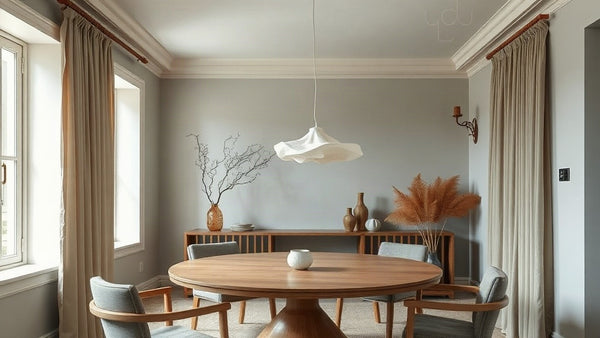
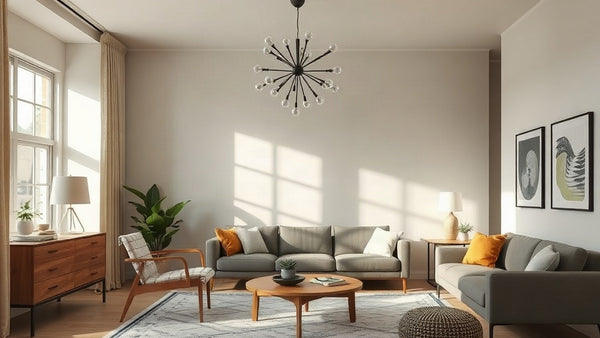
Ideal for visual interest in lobbies, dining areas, and feature spaces. Select designs with enclosed or semi-enclosed shades to minimize dust accumulation. Avoid exposed bulbs or complex geometries that create cleaning challenges. The modern lighting collection at Nauradika includes mid-century and Scandinavian designs that translate well to hospitality contexts—clean geometry, integrated dimming compatibility, and proven durability in commercial applications.
Recessed and Surface-Mounted Downlighting
The workhorse of hotel lighting. Specify anti-glare trim for guest-facing areas; baffle or reflector designs rated for 15–30° viewing angles. For corridors and back-of-house, standard trim is acceptable. Ensure thermal management: in recessed applications above insulated ceilings, specify IC-rated (insulation contact) housings.
Wall Sconces and Bedside Lighting
Guest rooms typically pair recessed ambient with bedside sconces (one per side, integrated with wall switches and USB charging per current expectations). Specify sconces with narrow light distribution (±45°) to avoid glare while reading. Swing-arm variants allow flexibility for varied room layouts.
Corridor and Stairwell Specification
Often overlooked but essential to guest safety and experience. Maintain 300+ lux at floor level with directional control. Emergency egress lighting must be independently wired and tested per building code; ensure your lighting design integrates these requirements rather than treating them as afterthought.
Control Systems and Occupancy Response
Modern hotel lighting increasingly incorporates occupancy sensors and daylight harvesting, particularly in back-of-house and common corridors. For guest rooms, provide manual override—guests expect control. Battery-backed emergency lighting and integration with property management systems (PMS) for housekeeping notification when lights are left on are now standard practice.
If your brief includes energy performance targets, specify 0.8–1.2 W/m² installed load for ambient hotel lighting; hospitality lighting can achieve this without compromise on quality through careful layer design and LED efficacy selection.
Budget Considerations and Trade Pricing
Hospitality projects typically operate under tighter per-room or per-square-metre lighting budgets than residential work, but the specification complexity is higher. Mid-century and retro design aesthetics offer particular value in hospitality contexts: they read as intentional and crafted without premium pricing, and their geometric simplicity performs well under continuous use.
If you're specifying across multiple properties or a large portfolio, discuss your project parameters with specialists. Nauradika offers a Nauradika trade discount programme for architects and designers on volume specifications, which can improve project economics.
Specifying Summer-Ready Interiors
As June approaches and interior design increasingly acknowledges seasonal variation, consider how your hotel lighting performs in summer conditions. Bright daylight reduces reliance on artificial lighting and can expose design weaknesses—poor colour rendering becomes obvious when daylight mingles with electric light, and glare becomes more pronounced. Specify dimmable systems with sufficient control authority to manage this seasonal shift. In Mediterranean or tropical contexts, consider external shading strategies that work in concert with interior hotel lighting to maintain comfort and colour accuracy year-round.
Final Specification Checklist
- Colour temperature mapping by space and time of day (2700K bedrooms evening, 4000K public morning areas)
- Illuminance levels confirmed for specific tasks and circulation needs
- LED lamp selection with verified dimming compatibility and colour consistency ratings
- Impact resistance and maintenance access confirmed for all surface-mounted and pendant fixtures
- Control strategy (manual, occupancy, daylight harvesting) aligned with operational workflow
- Emergency egress integration documented and code-verified
- Thermal management confirmed for recessed fixtures above insulated ceilings
- Sample fixtures reviewed in the actual project environment before full specification
Hotel lighting specification demands precision, but it also offers genuine creative opportunity. The discipline of functional constraint often produces stronger design than unlimited budgets. By treating hotel lighting as a systems challenge rather than a decorative choice, you create environments that guests notice only in their absence—the highest compliment hospitality design can receive.
Nauradika Trade