Hospitality interiors have always been where the most ambitious lighting decisions get made. Hotels and restaurants operate under a different set of constraints from residential projects — higher footfall, more demanding maintenance requirements, tighter fire and safety compliance — but they also offer something residential projects rarely do: the freedom to be genuinely bold. A dining room in a private house needs to work for breakfast as well as dinner, for children doing homework as well as adults entertaining. A restaurant dining room has one job: to make guests feel that they are somewhere worth being.
Lighting is the single most powerful tool available to the hospitality designer for achieving this. And increasingly, the lighting language that delivers most effectively in hotel and restaurant environments is not contemporary minimalism — it is the warm, characterful, materially rich aesthetic of retro and 1970s design. This guide covers how to specify retro mushroom lamps, mushroom style wall lights, and the broader vocabulary of 70s-influenced lighting for hotel lighting and restaurant lighting projects.
Why retro lighting works so well in hospitality
The relationship between retro design and hospitality is not nostalgic — or at least, not primarily nostalgic. It is atmospheric. The warm amber tones of 1970s Italian glass, the soft diffused glow of a mushroom pendant, the sculptural presence of a sputnik chandelier in a double-height bar — these create environments that feel distinctive, curated, and worth returning to. In an era when boutique hotel guests and restaurant patrons are increasingly photographing their surroundings and sharing them, lighting that creates a strong visual atmosphere has a value that extends well beyond the immediate experience of the guests in the room.
There is also a practical dimension. The warm colour temperatures — 2200K to 2700K — that retro-influenced lighting typically employs are the most flattering available for both food and human skin tones. A restaurant lit with warm amber glass pendants and mushroom wall lights will make every dish look better and every guest look more attractive than the same room lit with cool white recessed downlights. This is not a secondary consideration in hospitality — it is central to the guest experience.
Mushroom style wall lights in hotel bedrooms and corridors
The mushroom style wall light is one of the most versatile pieces in the hospitality specifier's toolkit. Its organic form, diffused light quality, and compact footprint make it well suited to a wide range of applications within a hotel or serviced apartment environment.
In hotel bedrooms, the mushroom wall light works as a bedside reading light, a corridor nightlight, or a low-level ambient source in the sitting area of a suite. Mounted at bedside height — 130–145cm above finished floor level — it delivers the directed, dimmable reading light that hotel guests consistently rank as one of the most important features of a bedroom. The organic form also ages well in a contract environment: the rounded, smooth surfaces of a mushroom shade are more forgiving of the minor scuffs and contact marks that accumulate in high-occupancy bedrooms than the sharp edges of more geometric fittings.
In corridors, a series of mushroom wall lights at 1.5–2 metre intervals creates a warm, welcoming approach to guest rooms that is visually far superior to the standard recessed downlight corridor. The overlapping pools of warm light eliminate the institutional quality that plagues many hotel corridors, and the visible fittings — rather than invisible recessed sources — signal to guests that design decisions have been made deliberately throughout the property.
The Nordic Mushroom Lamp in Retro Glass and Iron from Nauradika is a strong starting point for hotel bedroom specification — the glass cap delivers the warm glow of the original 1970s pieces while the iron construction provides the durability required in a contract environment. For a more overtly retro aesthetic in a design-led boutique hotel, the Modern Mushroom LED Rechargeable Light offers the additional advantage of cable-free installation — particularly valuable in listed buildings or heritage properties where running new cables to wall positions is impractical or subject to planning restrictions.
Retro mushroom pendants in restaurant and bar spaces
In restaurant dining rooms and bar areas, the retro mushroom pendant operates at a larger scale and with greater visual ambition than its wall-mounted equivalent. A mushroom pendant of 40–50cm diameter hung 65–70cm above a dining table creates a defined dining zone within a larger space, delivering warm directed light onto the table surface while the organic form contributes a sculptural quality to the room above.
For restaurants with an open kitchen or a counter dining format, mushroom pendants hung at lower heights — 55–65cm above the counter surface — create the intimate, focused atmosphere that distinguishes destination dining from the merely functional. At this height, the pendant shade enters the peripheral vision of seated guests, framing their view of the room and reinforcing the sense of being in a considered, designed environment rather than simply a room with tables in it.
For bar areas, mushroom pendants work best in clusters — three or five pendants at varying heights above the bar itself, with single pendants marking the positions of high stools or stand-up areas along the bar front. The variation in height creates visual interest and avoids the regimented quality of pendants hung at identical heights, which can feel institutional rather than atmospheric.
The specification challenge in bar applications is durability. Bar environments are demanding: pendants are frequently brushed by standing guests, exposed to humidity and condensation from ice and glassware, and subjected to cleaning regimes that can be harsh on delicate materials. For bar specification, prioritise pieces with robust construction — metal bases, thick glass or acrylic caps, and fixing mechanisms that can be tightened without disassembly. The 60s Italy Designer Mushroom Table Lamp meets these criteria — the construction quality is appropriate for a contract bar environment while the form retains all the character of the original Italian studio pieces.
Restaurant lighting beyond the pendant: layering for atmosphere
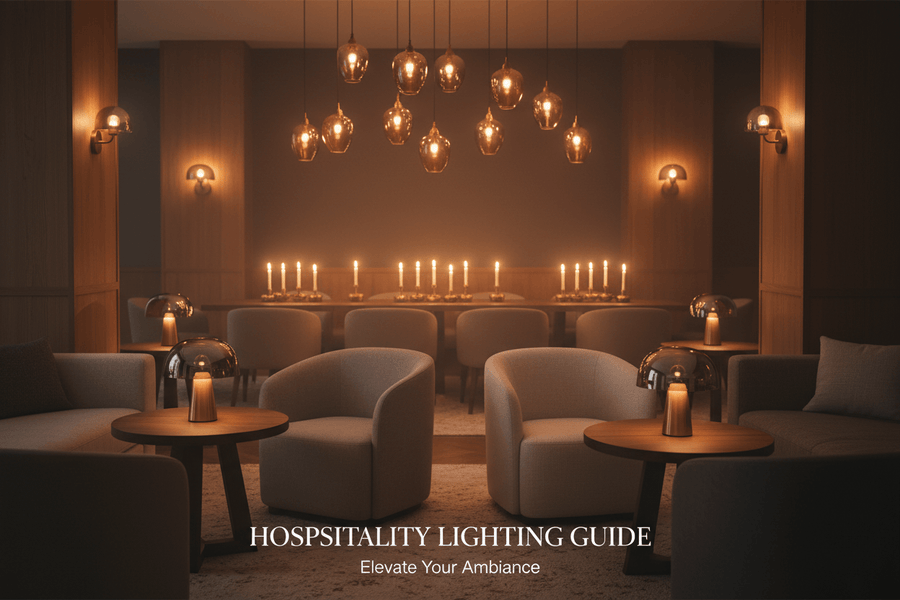
The most atmospheric restaurant spaces use lighting at multiple levels simultaneously. The pendant over the table provides the primary dining illumination. Wall lighting at intermediate height creates depth and activates the perimeter of the room. Low-level accent lighting — on shelving, beneath counters, in alcoves — adds the final layer of warmth and complexity that distinguishes a genuinely designed environment from a room that has simply been furnished and lit.
For a restaurant with a 1970s-influenced aesthetic direction, the wall lighting layer is typically the most important design decision after the pendant choice. Mushroom style wall lights, Italian glass sconces, or mid-century modern uplighters along the dining room perimeter create the warm, enveloping quality that retro-influenced restaurants achieve at their best. The wall lighting should be on its own dimmer circuit, independent of the pendant circuit, so that the ambient level can be adjusted through service — brighter for lunch, progressively warmer and dimmer through the dinner service.
The Art Deco Sconces from Nauradika work particularly well in this perimeter application for restaurants with a warm, period-influenced aesthetic. For a more overtly 1970s direction, the Lava Glass Wall Lamp — with its warm amber glass and organic form — creates exactly the kind of ambient wall light quality that makes a restaurant feel like an event rather than a meal.
Hotel lobby and public area lighting
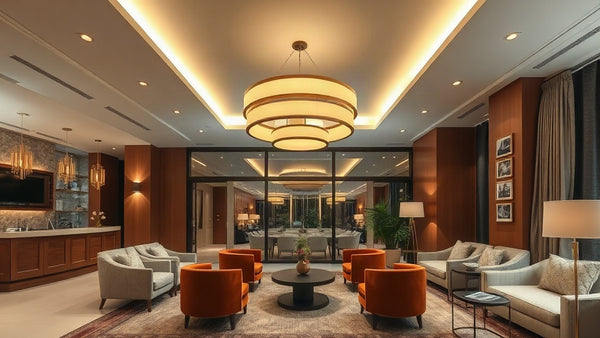
The hotel lobby is the property's first and most lasting impression — the space that establishes the design register of the entire property and sets guest expectations for everything that follows. Hotel lighting in public areas needs to achieve three things simultaneously: adequate illumination for practical wayfinding and reception use, strong visual atmosphere that communicates the property's positioning, and a quality of light that flatters guests from the moment they arrive.
For design-led boutique hotels with a retro or mid-century modern direction, the lobby pendant is often the single most important specification decision in the project. A large-scale sputnik chandelier or a cluster of Italian glass pendants in a double-height entrance hall communicates the property's aesthetic credentials immediately and memorably. These are the images that appear in hotel reviews, on social media, and in the photography that drives bookings.
The Luxury Hotel Tubular Golden LED Chandelier is designed precisely for this application — the scale is appropriate for double-height lobby spaces, the golden finish communicates warmth and quality, and the integrated LED technology means running costs and maintenance requirements are significantly lower than equivalent incandescent or halogen specifications. For properties with a more intimate, boutique scale, the Elegant Mid-Century Modern Pendant Light — specifically designed for hotel lobby and dining room applications — delivers the right scale and visual quality for smaller entrance spaces.
Compliance and practical considerations for hospitality specification
Hospitality lighting specification involves compliance considerations that do not apply in residential projects. A brief checklist for specifiers:
IP ratings: any fitting in a bathroom, spa, or pool area must meet the IP rating requirements for the specific zone. IP44 is the minimum for zone 2 bathroom applications; IP65 or above is required for zone 1 and outdoor applications. Check IP ratings on all Nauradika product pages before specifying for wet areas.
Fire safety: pendant fittings in escape routes must comply with the relevant fire safety regulations for the jurisdiction. In the UK, this typically means specifying fittings that do not present an obstruction at the required escape route clearance height. Confirm with the fire safety consultant on the project.
Energy performance: commercial lighting installations in the UK are subject to the Building Regulations Part L requirements for energy efficiency. LED fittings meeting the required efficacy levels are standard across the Nauradika range, but confirm specifications with the mechanical and electrical engineer on the project.
Maintenance access: in any commercial hospitality environment, consider how each fitting will be accessed for bulb replacement, cleaning, and eventual replacement. Fittings that require specialist access equipment or significant disassembly to maintain will create ongoing operational costs that affect the total cost of ownership.
Nauradika's full range of retro and vintage light fixtures includes pieces suitable for the full range of hospitality applications — from boutique hotel bedrooms to restaurant dining rooms and lobby spaces. We offer trade accounts with project pricing for hospitality designers, architects, and commercial specifiers — register for a trade account here to discuss your project requirements.
Nauradika Trade