Every room has a ceiling. Most rooms ignore it. The architects and interior designers who produce the most memorable interiors are those who treat the ceiling plane as an opportunity rather than an afterthought — and nothing activates a ceiling more immediately or more dramatically than a well-chosen statement ceiling light.
This guide is for those making serious lighting decisions on residential or commercial projects: how to evaluate a statement pendant against the specific demands of a room, how to use colour and material to push a scheme further, and where to find pieces that deliver genuine design quality at project-viable prices. We will pay particular attention to the retro revival happening in 2026 — the return of warm-toned glass, organic forms, and the bold chromatic confidence of 1970s Italian and Scandinavian design.
What makes a ceiling light a statement
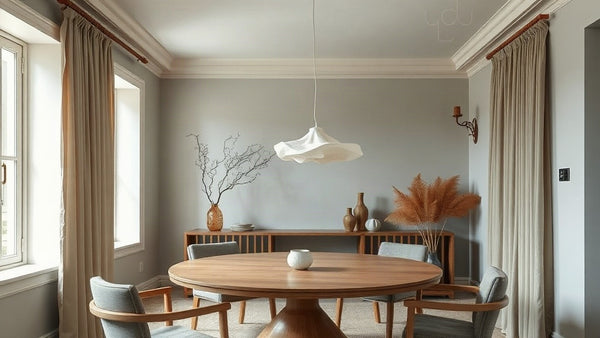
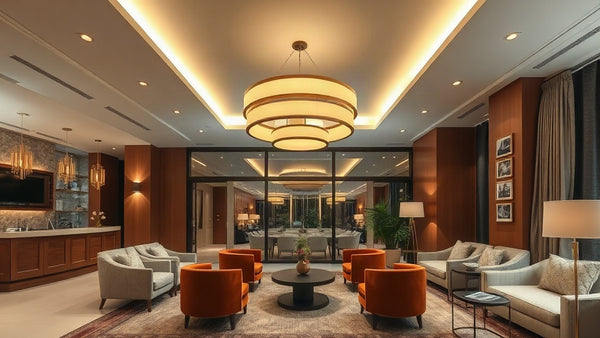
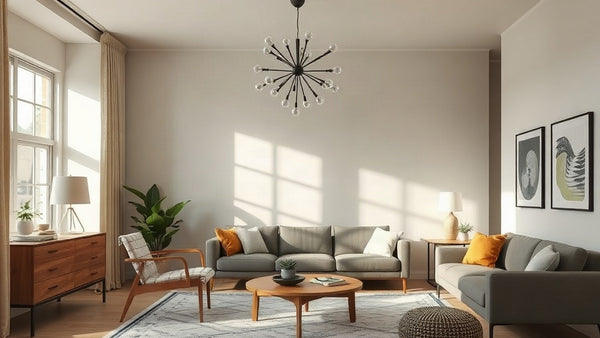
The word "statement" is overused in interiors — applied so broadly it has almost lost meaning. For the purposes of specification, a statement ceiling light is one that performs a primary compositional role in the room: it is the first thing the eye finds when you enter, it establishes the vertical scale of the space, and it sets the tonal register against which everything else is read.
This is a different brief to ambient lighting. A recessed downlight grid provides ambient light. A statement pendant provides presence. The two are not mutually exclusive — a well-designed pendant will also light the room adequately — but the primary function of a statement fixture is architectural and spatial, not merely functional.
Three variables determine whether a ceiling light achieves statement status in a given room:
- Scale relative to the room: a pendant that is too small for its ceiling height reads as tentative. Err larger than instinct suggests — a fixture that fills the vertical space with confidence will always outperform one that disappears into it.
- Material quality and light interaction: how the material behaves in both lit and unlit states matters. A smoked glass pendant in daylight is a sculptural object; at night, with a warm bulb, it becomes something else entirely. The best statement fixtures work in both conditions.
- Relationship to the room's palette: a statement light that fights the room is a distraction. One that amplifies the room's existing tonal direction — warmer, cooler, brighter, more muted — creates coherence.
The 1970s orange pendant: colour as architecture
One of the most significant shifts in residential lighting specification in 2026 is the return of colour. After a decade of matte black, brushed brass, and white — all excellent, all now somewhat predictable — designers and their clients are reaching for something warmer, more expressive, and more specific.
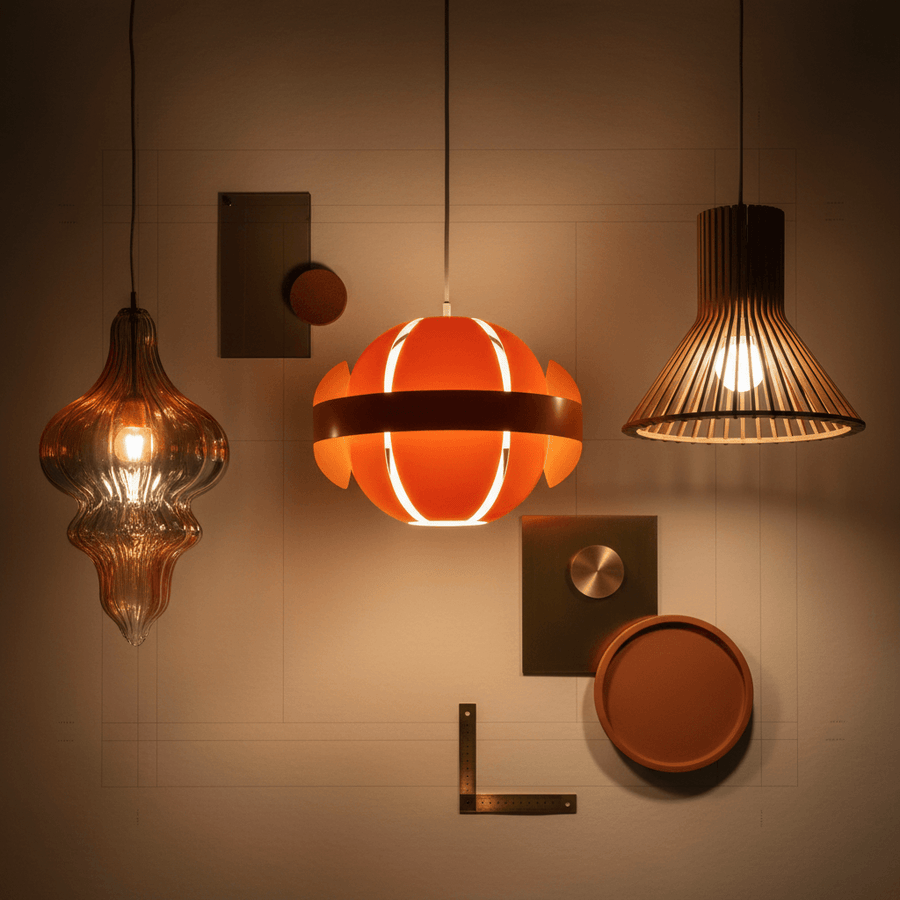
The orange pendant lamp is the clearest expression of this shift. Orange — particularly in the amber, rust, and terracotta registers that dominated 1970s Italian and Scandinavian design — reads as simultaneously warm and sophisticated. It does not clash with natural materials; it intensifies them. Against oak, it deepens the grain. Against white plaster, it becomes a focal point. Against green cabinetry, it creates the kind of complementary tension that makes a room feel considered rather than safe.
The 1970s orange pendant is not a novelty or a trend piece in the pejorative sense. It is a return to a design language that was interrupted, not exhausted. The original pieces — produced by Italian and Scandinavian studios in the late 1960s and through the 1970s — were among the most thoughtfully designed lighting objects of the twentieth century. They deserve the reassessment they are currently receiving.
For those ready to commit to colour, the Nordic Sunset Orange Pendant Light from Nauradika is an outstanding starting point — a retro acrylic glass form in a warm amber-orange that performs as confidently in a kitchen over an island as it does hanging low over a dining table. For a more dramatic scale, the Retro Orange Pendant Light brings the full visual weight of 1970s Italian design to contemporary interiors.
Italian glass pendants: the material that changes everything
If orange is the colour story of the 2026 statement ceiling revival, Italian mouth-blown glass is the material story. The italian glass pendant occupies a unique position in the lighting canon: it is simultaneously one of the oldest craft traditions in European decorative arts and one of the most contemporary-feeling choices you can make in a room today.
The reason Italian glass works so consistently well as a statement ceiling material is the way it handles light from the inside. Unlike metal, ceramic, or fabric shades — which absorb and reflect light — glass transmits it. A blown glass pendant with a warm incandescent or LED filament bulb does not merely illuminate; it glows. The entire object becomes a light source, with the variations in the glass — thickness, colour, texture, bubbles — creating a quality of light that no other material can replicate.
For contemporary specification, Italian-influenced glass pendants divide broadly into three categories:
- Clear and smoked glass: the most versatile. Works with almost any room palette, allows the bulb to become a design feature. Best in rooms with a strong architectural geometry where the pendant's form needs to be legible.
- Coloured glass: amber, green, rust, smoke — these are the statement variants. The colour shifts dramatically with the light temperature of the bulb: a warm 2200K source through amber glass creates something entirely different from a cooler 3000K source through the same material.
- Textured and patterned glass: the most historically specific. Murano-influenced ribbing, dimpling, and surface patterning were defining characteristics of 1970s Italian glass production. Used in contemporary interiors, they read as knowing and confident rather than nostalgic.
The Italian Glass 70s Pendant Lights at Nauradika are the most direct expression of this tradition in our current range — warm, confident, and built around the material qualities that made Italian glass lighting the most coveted design category of its era. For something that pushes the glass form further into sculptural territory, the Luxurious Glass Disc Chandelier brings mid-century geometry together with the material warmth of hand-finished glass.
Sizing and hanging a statement ceiling light
The most common specification mistake with statement pendants is under-scaling. Here is a practical sizing framework:
For dining rooms: the pendant diameter should be approximately 50–60% of the table width. A 1.8m dining table wants a pendant of 90–110cm diameter, or a cluster with an equivalent visual footprint. Hang height: 65–75cm above the table surface.
For open-plan living and kitchen spaces: the pendant needs to be large enough to define the zone it sits over without being so large it visually compresses the room. For ceilings of 2.7m and above, a single pendant of 50–70cm diameter or a three-pendant cluster works well. For ceilings of 3m and above, scale up further — 70–90cm diameter for a single fixture.
For hallways and double-height spaces: a single large-scale pendant hung on an extended cord or chain is the most architecturally satisfying solution. The vertical dimension of the cord or chain becomes part of the composition — do not try to conceal it.
For bedrooms: a statement ceiling light in a bedroom should be on a dimmer without exception. At full brightness it serves as the primary light source; at 20–30% it creates the kind of warm, ambient glow that no bedside lamp can match on its own.
Layering a statement light with the rest of the scheme
A statement ceiling light works hardest when it is not asked to do everything. In a well-specified room, the pendant provides the anchor — the compositional centre — while wall lights, floor lamps, and task lighting handle the practical requirements. This layering is what distinguishes rooms that feel complete from rooms that feel like a single good idea surrounded by emptiness.
For rooms with a strong retro or mid-century direction, consider pairing an Italian glass or orange pendant above with more architectural wall lighting at a lower level. The contrast between the warm, organic ceiling form and the cleaner geometry of a wall-mounted sconce creates exactly the kind of designed tension that makes a room feel resolved.
Browse Nauradika's full collection of statement ceiling light fixtures — curated for designers, architects, and homeowners who want pieces with genuine design lineage at prices that work for real projects. Trade accounts with project pricing are available for professionals — register here.
Nauradika Trade