Lorsque vous spécifiez l'éclairage pour un projet hôtelier, qu'il s'agisse d'un hôtel-boutique de 40 chambres, d'un restaurant étoilé au Michelin ou d'une suite de réception d'entreprise, les enjeux sont considérablement plus élevés que pour un projet résidentiel. L'éclairage hôtelier doit répondre à de multiples exigences simultanées : il doit flatter les clients, soutenir l'efficacité opérationnelle, résister à une utilisation quotidienne intensive et communiquer le récit du design de l'établissement sans attirer excessivement l'attention.
L'évolution vers des approches sophistiquées et superposées de l'éclairage hôtelier s'est considérablement accélérée. Selon le rapport de Lumenture sur les tendances d'éclairage 2026, les designers d'hôtels s'éloignent de la luminosité uniforme pour adopter des schémas contextuels et adaptés à l'espace, qui reconnaissent la façon dont la lumière façonne l'ambiance, l'orientation et la valeur perçue. C'est un contrepoint bienvenu aux hôtels génériques et surexposés qui dominent encore le secteur économique.
Comprendre la hiérarchie de l'éclairage hôtelier
L'éclairage hôtelier n'est pas monolithique. Votre cahier des charges doit couvrir au moins trois zones distinctes, chacune ayant des exigences différentes :
- Zones publiques (halls, restaurants, bars) : C'est là que l'éclairage devient architecture. C'est la première expérience sensorielle, et elle établit les attentes en matière de qualité et de positionnement.
- Chambres d'hôtes : Les exigences fonctionnelles dominent ici — lumière de lecture, éclairage d'ambiance et éclairage de travail autour des zones de toilette — mais l'exécution esthétique détermine le luxe perçu.
- Arrière-boutique et circulation : Souvent négligé mais essentiel pour l'expérience du personnel et la sécurité opérationnelle. Les couloirs sous-éclairés et les cages d'escalier sombres créent des responsabilités et de mauvaises conditions de travail.
L'éclairage des restaurants mérite sa propre catégorie dans la planification de l'éclairage hôtelier. Contrairement aux hôtels, où les clients se retirent dans des chambres privées, les environnements de restaurant doivent maintenir l'engagement tout au long de la soirée. L'indice de rendu des couleurs (IRC) de votre éclairage affecte directement l'apparence des aliments, la façon dont les visages sont flattés et, finalement, la valeur perçue de l'expérience culinaire.
Normes de spécification pour l'éclairage hôtelier
Commencez par les niveaux de lux, mais ne laissez pas cela devenir votre seule mesure. La Society of Light and Lighting (SLL) fournit des directives, mais considérez-les comme des bases plutôt que des objectifs :
- Halls d'hôtel : 300 à 500 lux (plan horizontal) selon l'intention esthétique
- Zones de restauration : 150 à 200 lux pour la gastronomie, 200 à 300 lux pour la restauration décontractée
- Ambiance des chambres : 50 à 150 lux (couches sur plusieurs circuits)
- Lecture au chevet : 300 à 500 lux au plan de travail
- Toilettes dans la salle de bain : 300 à 500 lux au miroir
Mais la spécification de l'éclairage hôtelier exige plus de nuance. La température de couleur est non négociable : 2700K (blanc chaud) est désormais une base pour tout établissement se positionnant au-dessus du budget. Les sources à IRC élevé (95+) sont essentielles pour les environnements de restaurant et de salle à manger. Et surtout, la gradation sur tous les circuits n'est plus une option, elle est attendue. Les clients veulent le contrôle.
Langage des matériaux et direction esthétique
Le meilleur éclairage d'hôtel semble inévitable, comme si le designer n'avait fait aucun choix. Cela nécessite une cohérence matérielle. Si votre cahier des charges inclut le laiton, assurez la cohérence sur tous les luminaires. Si vous travaillez avec de l'acier thermolaqué, engagez-vous. Les métaux mélangés sont une preuve d'indécision.
Les références du milieu du siècle restent dominantes dans le design hôtelier, en particulier le vocabulaire scandinave aux lignes épurées qui suggère la qualité sans ostentation. Les collections d'éclairage moderne qui s'inspirent de ces langages de design offrent la crédibilité esthétique que les hôtels-boutiques contemporains attendent, tout en restant faciles à spécifier pour les architectes travaillant avec des budgets réalistes.
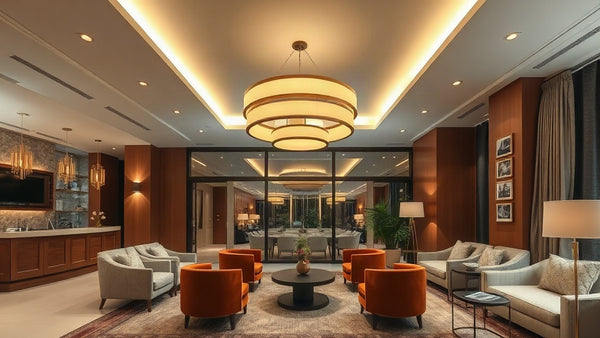
Considérez également le potentiel théâtral du choix des luminaires. Un lustre ou une suspension sculpturale bien choisi devient un point focal qui justifie son emprise spatiale. Les lustres de luxe pour hôtel avec technologie LED offrent désormais la présence visuelle des pièces traditionnelles sans production de chaleur, charge d'entretien ou pénalités énergétiques – un avantage matériel dans les cuisines commerciales ou les zones de bar bondées.
Spécification et systèmes de contrôle LED
D'ici 2026, la LED sera non négociable pour toute nouvelle spécification d'éclairage hôtelier. Les avantages en termes d'efficacité et de longévité sont une base. Ce qui compte maintenant, c'est la cohérence des couleurs et les performances anti-scintillement.
- Cohérence des couleurs (SDCM) : Spécifiez une ellipse de MacAdam de ≤3 pas pour tous les luminaires visibles. L'éclairage d'hôtel des zones publiques ne peut tolérer le décalage de couleur qui se produit entre les lots de LED moins chères.
- Scintillement : La conformité IEEE 1789 est essentielle, en particulier dans les environnements de restaurant et de bar où du contenu vidéo peut être enregistré. Les pourcentages de scintillement doivent être inférieurs à 3,2 % pour les applications les plus sensibles.
- Performances de gradation : Une gradation de 0 à 100 % sans décalage de couleur est désormais standard dans les systèmes correctement spécifiés. Assurez-vous que votre protocole de contrôle (DALI, DMX, sans fil) est décidé tôt et coordonné avec le MEP.
Le contrôle de l'éclairage hôtelier a considérablement mûri. Plutôt que de spécifier des modules de gradation individuels pour chaque circuit, la pratique contemporaine favorise les systèmes basés sur des zones qui permettent au personnel de rappeler des scènes prédéfinies. Cela réduit la complexité opérationnelle et assure la cohérence.
Considérations relatives aux urgences et à la conformité
La spécification de l'éclairage hôtelier ne peut être dissociée de l'éclairage d'évacuation d'urgence et des exigences d'accessibilité. Ce ne sont pas des réflexions secondaires :
- L'éclairage d'urgence doit atteindre un éclairement minimal dans les 0,3 secondes suivant une coupure de courant
- L'éclairage d'orientation dans les couloirs et les cages d'escalier doit faciliter une navigation sûre sans provoquer de désorientation
- Le contrôle de l'éblouissement est essentiel — l'éblouissement d'incapacité est particulièrement problématique chez les populations vieillissantes et doit être géré par la sélection et le positionnement des luminaires
- Les niveaux de lumière pour les tâches visuelles doivent tenir compte du déclin visuel lié à l'âge ; une personne de 60 ans a besoin d'environ deux fois plus d'éclairage qu'une personne de 20 ans pour des performances de tâche équivalentes
Ce ne sont pas des contraintes à minimiser ; ce sont des opportunités de démontrer une conception réfléchie qui tient compte de la variabilité humaine.
Considérations saisonnières : conception hôtelière estivale
L'été apporte des défis particuliers à la spécification de l'éclairage hôtelier. Les heures de clarté prolongées signifient que l'éclairage artificiel devient moins dominant dans les espaces publics diurnes, mais l'éclairage du soir doit toujours soutenir le récit de la propriété.
C'est un moment idéal pour envisager un éclairage d'accentuation et des luminaires sculpturaux qui fonctionnent aussi bien le jour (comme objets visuels) que la nuit (comme sources lumineuses). L'éclairage suspendu au-dessus des terrasses extérieures devrait mettre l'accent sur une température de couleur chaude (2700K ou plus chaude) pour soutenir la biologie des insectes et créer une atmosphère intime à mesure que la lumière naturelle diminue.
Le contrôle de l'éblouissement devient plus critique dans les schémas estivaux. Un éclairage à haute température de couleur (froid) dans les espaces extérieurs ou semi-extérieurs peut produire un éblouissement inconfortable dans des conditions extérieures lumineuses. Un éclairage chaud et tamisé aide les clients à passer psychologiquement de la chaleur et de la luminosité extérieures à des conditions intérieures plus contemplatives.
Collaboration avec les fabricants et gestion budgétaire
La spécification de l'éclairage hôtelier ne doit pas être coûteuse, mais elle exige de la discipline. Établissez un budget par chambre ou par mètre carré d'espace public, puis priorisez sans relâche. Éclairage d'ambiance dans les espaces publics ; éclairage de travail efficace et robuste en arrière-boutique ; éclairage ambiant soigneusement étudié mais économique dans les circulations.
Si vous spécifiez pour plusieurs types de chambres ou un projet hôtelier plus vaste, renseignez-vous si le fabricant offre des tarifs professionnels. Le programme de remises professionnelles de Nauradika est disponible pour les architectes et designers spécifiant pour des projets commerciaux, ce qui peut améliorer significativement l'économie du projet sans compromettre l'intention esthétique.
Coordination et transfert
La spécification de l'éclairage hôtelier est avant tout une question de performance lors de la réception. Cela exige :
- Des tableaux détaillés des luminaires avec des données photométriques et des affectations de contrôle
- Des protocoles de gradation clairs documentés pour le personnel d'exploitation
- Des visites sur site pendant la mise en service pour valider que les conceptions théoriques fonctionnent comme prévu à différents moments de la journée
- Une documentation de formation pour le personnel de maintenance sur les considérations spécifiques aux LED (cohérence des couleurs, gestion thermique)
La différence entre un éclairage d'hôtel adéquat et un éclairage d'hospitalité exceptionnel réside dans ces détails. C'est le fruit d'une spécification réfléchie, et non d'une inspiration.
Conclusion : le contexte avant les tendances
La conception d'éclairage hôtelier en 2026 récompense la clarté d'intention. Les projets les plus réussis ne sont pas nécessairement les plus chers ou les plus à la mode – ce sont ceux qui comprennent comment la lumière sert le programme spécifique de l'espace et les attentes de ses utilisateurs. Que vous conceviez un éclairage de restaurant avec un rendu des couleurs sophistiqué, un éclairage d'hôtel ambiant qui s'adapte à l'heure de la journée, ou un éclairage hôtelier qui fonctionne pour plusieurs groupes d'utilisateurs, commencez par une spécification rigoureuse et laissez la direction esthétique découler de la clarté fonctionnelle.
Nauradika Trade