L'éclairage hôtelier en 2026 : Le virage de Wimberly Interiors vers la chaleur et la narration
Les derniers projets hôteliers de Wimberly Interiors marquent un virage décisif, délaissant l'uniformité stérile et corporative au profit d'environnements riches en caractère. Pour les architectes qui conçoivent des hôtels et des restaurants cet été, les implications sont claires : l'éclairage hôtelier doit désormais fonctionner à la fois comme une infrastructure fonctionnelle et comme un dispositif de narration expérientielle.
Le paysage de l'éclairage hôtelier en 2026 reflète un réétalonnage fondamental des attentes des clients. Les voyageurs contemporains – qu'ils séjournent dans un hôtel-boutique ou un restaurant gastronomique – exigent des espaces qui semblent curatés plutôt que standardisés. Cela requiert une précision dans la spécification de l'éclairage et une compréhension de la manière dont l'intensité lumineuse, la température de couleur et l'emplacement des luminaires contribuent au confort psychologique et au succès commercial.
Spécifications clés pour la conception d'éclairage hôtelier contemporain
- Plages de température de couleur : 2700K–3000K pour les chambres et les repas intimes ; 3000K–4000K pour la circulation et les zones fonctionnelles
- Capacité de gradation : Essentielle dans tous les espaces accueillant des clients. Recommander une gradation de 0 à 100 % avec un fonctionnement fluide et sans scintillement
- IRC (Indice de Rendu des Couleurs) : Minimum 90 pour l'éclairage des restaurants ; 95+ pour les environnements hôteliers haut de gamme
- Efficacité énergétique : Spécification LED généralisée ; systèmes de contrôle DALI ou 0–10V pour une gestion centralisée
Éclairage de restaurant et d'hôtel : l'approche narrative
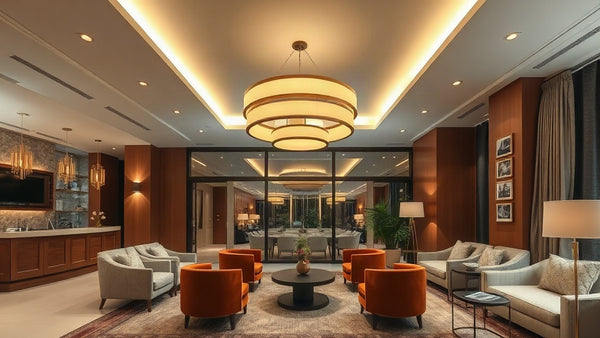
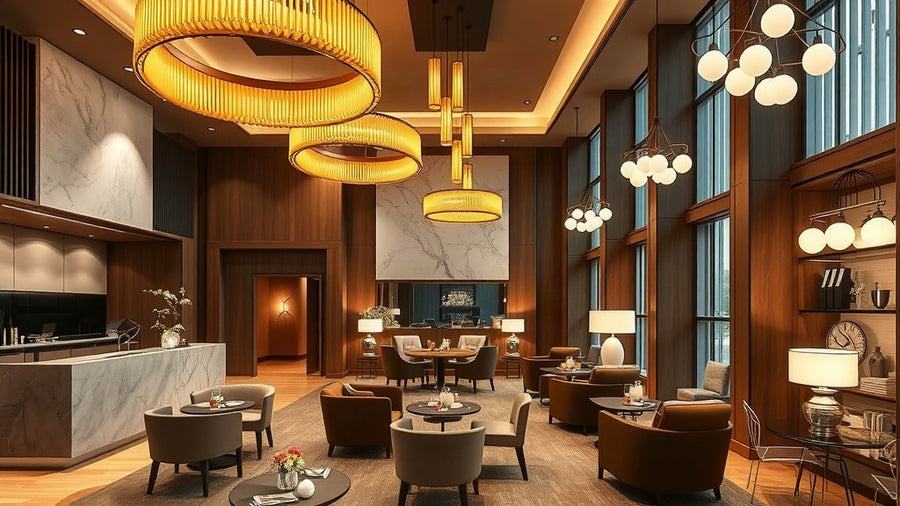
La conception de l'éclairage de restaurant exige désormais de la subtilité. La philosophie de Wimberly Interiors — évidente dans les projets hôteliers de 2026 — met l'accent sur les luminaires comme éléments sculpturaux qui contribuent à la narration spatiale plutôt que de simplement éclairer des surfaces. Cette approche de l'éclairage hôtelier signifie choisir des suspensions, des appliques murales et des systèmes d'éclairage ambiant qui méritent une inspection minutieuse.
Les luminaires d'inspiration moderniste du milieu du siècle et scandinave s'alignent particulièrement bien avec cette tendance. Leurs géométries épurées et l'honnêteté de leurs matériaux créent un intérêt visuel sans encombrement visuel, tandis que leur conception ergonomique éprouvée assure une distribution optimale de la lumière pour le confort des clients et la fonctionnalité du personnel.
Mise en œuvre pratique : systèmes d'éclairage superposés
Un éclairage hôtelier efficace combine trois couches distinctes :
- Ambiant : Solutions encastrées ou en surface fournissant un éclairage de base (200–300 lux dans les chambres ; 300–500 lux dans les espaces publics)
- De tâche : Éclairage ciblé pour des fonctions spécifiques – lecture au chevet, travail de bureau, service au bar – typiquement 500+ lux au point d'utilisation
- D'accent : Luminaires décoratifs et systèmes de lavage de mur qui établissent la hiérarchie spatiale et l'intérêt visuel
Pour les projets de l'été 2026, les palettes intérieures plus claires exigent une planification minutieuse des lux. Les surfaces réfléchissantes amplifient le rendement lumineux ; compenser en sélectionnant des luminaires avec un contrôle directionnel pour éviter l'éblouissement sur les murs et les meubles pâles.
Spécifier pour la durabilité et l'entretien
L'éclairage hôtelier commercial doit concilier intention esthétique et longévité pratique. Les modules LED scellés d'une durée de vie de plus de 50 000 heures, une construction mécanique robuste et des composants de remplacement facilement disponibles sont non négociables. L'approche de Wimberly met l'accent sur un design intemporel précisément parce qu'elle résiste à une obsolescence rapide, une considération essentielle pour les projets hôteliers à forte intensité de capital.
Pour les architectes qui élaborent des plans d'éclairage d'hôtel, le précédent de 2026 est sans ambiguïté : privilégiez le choix des luminaires qui combinent une spécification rigoureuse, une finalité spatiale et une intégrité de conception. Les clients et les investisseurs de l'hôtellerie contemporaine n'acceptent plus les solutions génériques.
Découvrez le look à travers les options d'éclairage d'hôtel et les pièces associées dans notre collection Éclairage moderne.
Pourquoi ce style fonctionne
La bonne lumière fait plus qu'éclairer une pièce. Elle donne le rythme de l'espace, offre un point d'ancrage visuel aux meubles et aide un schéma décoratif à sembler intentionnel plutôt qu'assemblé. Pour les lecteurs arrivant de la recherche, cette section relie l'idée de conception à la sélection pratique de produits.
- Crée un point focal clair
- Ajoute chaleur et texture
- Fonctionne dans les pièces contemporaines et d'inspiration vintage
Comment choisir la bonne pièce
Commencez par l'échelle, puis le matériau, puis la température de la lumière. Une suspension ou une applique murale doit être proportionnée à la pièce et aux meubles qu'elle surplombe. Les matériaux naturels ont tendance à adoucir les intérieurs modernes, tandis que les finitions plus sombres peuvent créer un effet plus graphique.
- Vérifiez la hauteur du plafond et les dimensions des meubles
- Choisissez une finition qui se répète ailleurs dans la pièce
- Utilisez des ampoules chaudes pour les espaces de vie et de repas
Où l'utiliser
Ce style est particulièrement efficace dans les salles à manger, les chambres, les couloirs et les espaces hôteliers de charme où l'ambiance est essentielle. Il peut également fonctionner dans les rénovations où un simple changement d'éclairage doit rendre la pièce plus aboutie.
- Tables de salle à manger et îlots de cuisine
- Chambres et coins lecture
- Couloirs, restaurants et hôtels-boutiques
Découvrez le style
Pour les produits les plus pertinents, commencez par la pièce vedette de l'article et la collection correspondante. Le prix du produit, sa disponibilité et les images doivent être extraits en direct de Shopify lors du rendu du modèle.
Découvrez l'éclairage d'hôtel présenté ou parcourez la collection complète associée.
Présenté dans ce guide
Voir la collectionWhy this style works
Frequently asked questions
Nauradika Trade